
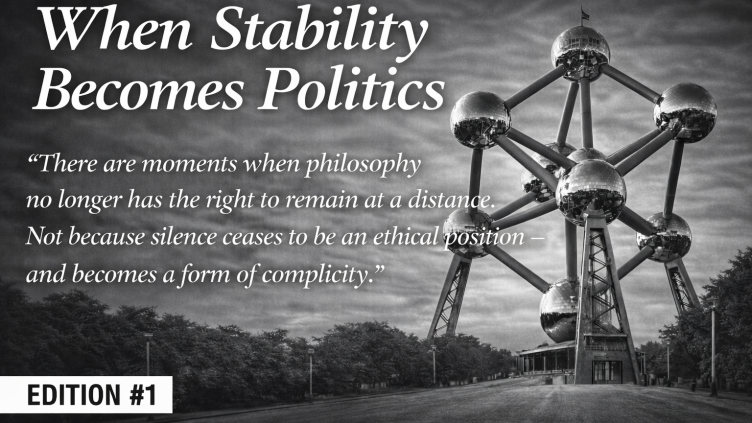
There are moments when philosophy no longer has the right to remain at a distance. Not because it must intervene. But because silence ceases to be an ethical position – and becomes a form of complicity.
This issue of the journal marks a transition from analytical silence to political form. Not as an act of activism. But as an attempt to restore thinking where politics is increasingly reduced to reaction, fear, or short-term gain.
We proceed from a simple, yet unpopular assumption: in the twenty-first century, stability is not born from victory, punishment, or moral ultimatums. It emerges where conflict loses its meaning as a sometimes profitable, but structurally destructive strategy.
History has already offered Europe this lesson.
After the catastrophe of the Second World War, peace between hereditary enemies was achieved not through emotional reconciliation, but through the integration of interests. The Schuman Plan did not demand affection – it demanded shared responsibility for resources without which war became impossible.
The British Empire did not collapse in a single moment – it transformed itself, integrating the loss of direct control into financial and institutional presence.
Japan, after Hiroshima and Nagasaki, was not erased as a subject – its power was redirected into a system of economic interdependence in which war lost its rationality.
In all these cases, one logic prevailed: power does not always need to be broken – sometimes it is enough to embed it in a system where destruction becomes unprofitable.
It is in this sense that we propose to view Europe not as an arbiter, a victim, or a passive observer, but as a potential architect of stability through economic linkage.
Not from a moral position. And not from a position of fear. But from a position of structural advantage, long horizons, and responsibility for its own continent.
This cycle does not offer ready-made solutions. It forms a framework within which solutions can become thinkable.
We do not appeal to conscience – history has shown its limitations in large-scale conflicts. We speak the language of interests, structures, and consequences.
Because where war becomes stable, peace must become more profitable. Otherwise, it will not come.
This is not a manifesto. It is an invitation to thinking – where reaction is no longer enough.

Leave a Reply