
Editor’s Note
This text is not merely another essay. It is an attempt to examine the very instrument we employ throughout this cycle. It stands at the beginning for a reason: everything that follows—power, conflict, identity, archetypes—should be read with the understanding that these, too, are forms. And that none of them are final.
Form is necessary
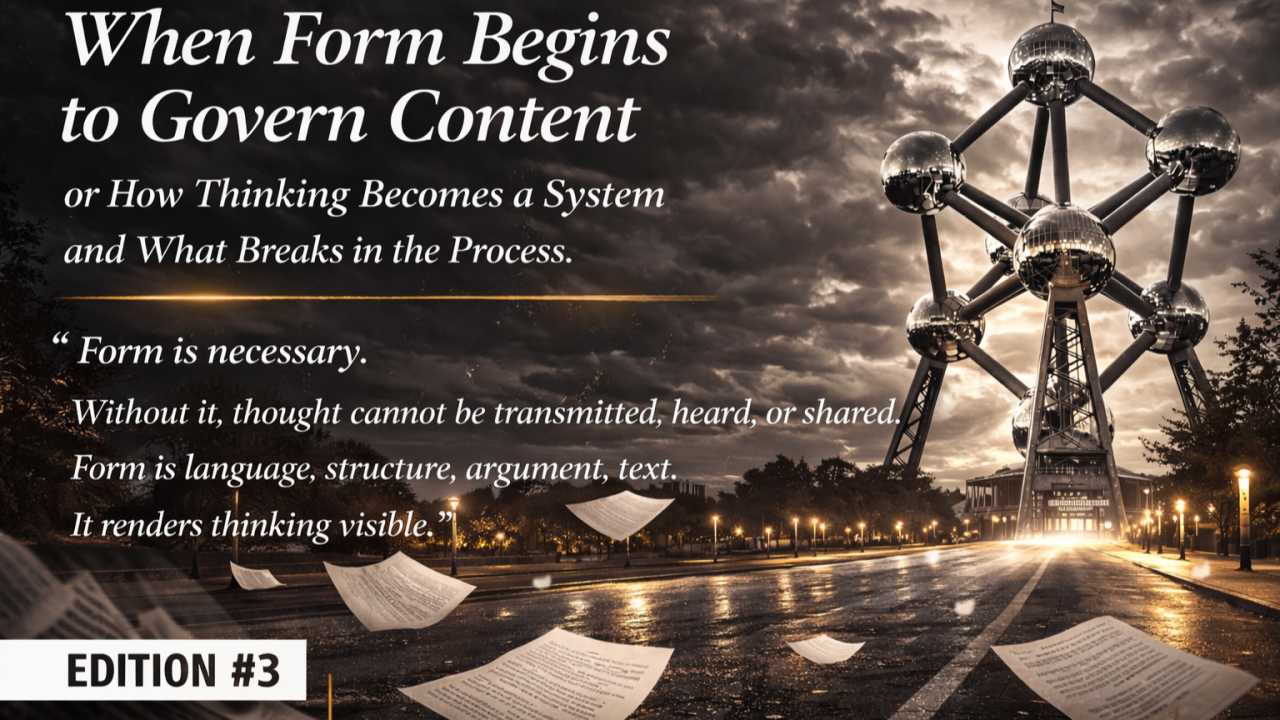
Without it, thought cannot be transmitted, heard, or shared. Form is language, structure, argument, text. It renders thinking visible.
Yet it is precisely at this moment that risk emerges. What was once a living process begins to seek completeness. What was once inquiry begins to seek stability. What emerged as a question begins to desire becoming an answer.
And here, form ceases to be an instrument. It begins to govern.
The Anatomy of the Shift: From Instrument to Idol
Thinking is born from uncertainty. Form, by contrast, always gravitates toward the definite. Initially, it assists, it holds complexity together, prevents fragmentation, maintains logic. It is a skeleton that allows the body to move.
But at a certain point, form begins to demand:
- coherence over honesty;
- consistency over precision;
- completion over openness.
Imperceptibly, thinking changes direction. It no longer questions. It confirms. From an instrument of cognition, form transforms into an idol demanding worship.
Where does this shift originate? Not from falsehood. Systems are born from the fatigue of uncertainty. The human psyche craves order, predictability, meaning. Form promises relief: clarity without tension, order without doubt, meaning without risk. And we willingly cede control.
Here are several illustrations of how form becomes a cage:
In science. Alfred Wegener’s theory of continental drift was ridiculed for decades—not because his arguments were weak, but because it did not fit the dominant geological paradigm. Form (fixism) rejected the reality that contradicted it.
In politics. Soviet political economy continued “proving” the superiority of central planning even as store shelves stood empty. Form (ideology) demanded that reality be adjusted, not that the form itself change.
In language. The Sapir-Whorf hypothesis reminds us: language is a form that can constrain thought. What lacks words is harder to notice, harder to comprehend.
In this cycle. Each of our texts is also a form. If we begin to defend them against criticism, to repeat them as dogma, we will cease to think. We will begin to function.
What Actually Breaks
When form governs, it is not logic that breaks. It is our relationship to reality.
- the complex becomes inconvenient – simplified or ignored;
- the contradictory becomes suspect – excluded;
- silence becomes superfluous – filled with noise.
The system cannot tolerate pauses. It requires constant confirmation. And then questions are perceived as threats, doubts as weakness, incompleteness as error.
What was once thinking becomes a mechanism of reproduction. Thought no longer moves. It functions.
Skeleton-Form and Cage-Form: How to Distinguish
If form is inevitable, can the trap be avoided? Yes, if we learn to distinguish between two types of form.
- Skeleton-form supports but does not constrain. It provides structure, allows movement, change, growth. It can be rebuilt without destroying the body.
- Cage-form has become rigid, defends itself, admits nothing new. It exists for its own sake, not for what it is meant to carry.
Criteria for distinction:
- The skeleton can be altered. The cage cannot – it breaks when transformation is attempted.
- The skeleton does not fear pauses, silence, doubt. The cage fears them: it requires constant affirmation.
- The skeleton asks, “what next?” The cage answers “this is how it must be.”
- The skeleton is vulnerable to reality. The cage is shielded from it by thick walls.
To think responsibly means constantly examining which form we inhabit. Does it serve us, or do we serve it?
The Responsibility of Thinking
Responsibility is not the rejection of form. It is a refusal to submit to it.
Responsible thinking:
- uses form without identifying with it;
- allows thought to reshape its own contours;
- leaves space for what does not yet have language.
It knows that any completion is temporary. Any clarity is partial. Any truth is perspectival.
It is here that what we have elsewhere called ‘the subject’ emerges. The subject is not one who possesses the final answer. It is one who can step outside form without destroying it and return without becoming its slave.
Silence, which we spoke of at the very beginning of this cycle, is not merely a pause. It is the space in which form can be reconsidered. Where we can ask ourselves: does this construction still serve? Has it become a cage?
In Place of a Conclusion: Silence as Reminder
Thinking does not break when it errors. It breaks when it can no longer change the form in which it speaks.
Where form becomes untouchable, thought disappears.
And this is why silence again becomes necessary. Not as an absence of words, but as a reminder that no form is final. That behind every construction lies something that cannot be contained within it. That life always exceeds its boundaries.
Later in this cycle we will speak of power, conflict, identity, archetypes. Each of these texts is also a form. We do not promise truth in the last instance. We promise only this: we will remember that these are temporary constructions, open to revision. And we invite you to do the same.
For genuine thinking begins where form recognizes its own temporality—and nonetheless dares to speak.
Afterword
This text continues the cycle for a reason. It sets the rules of engagement: we are not building a system; we are building instruments. And when they cease to function, we are prepared to change them. Even if they are our own texts.

Leave a Reply