
Editorial Note
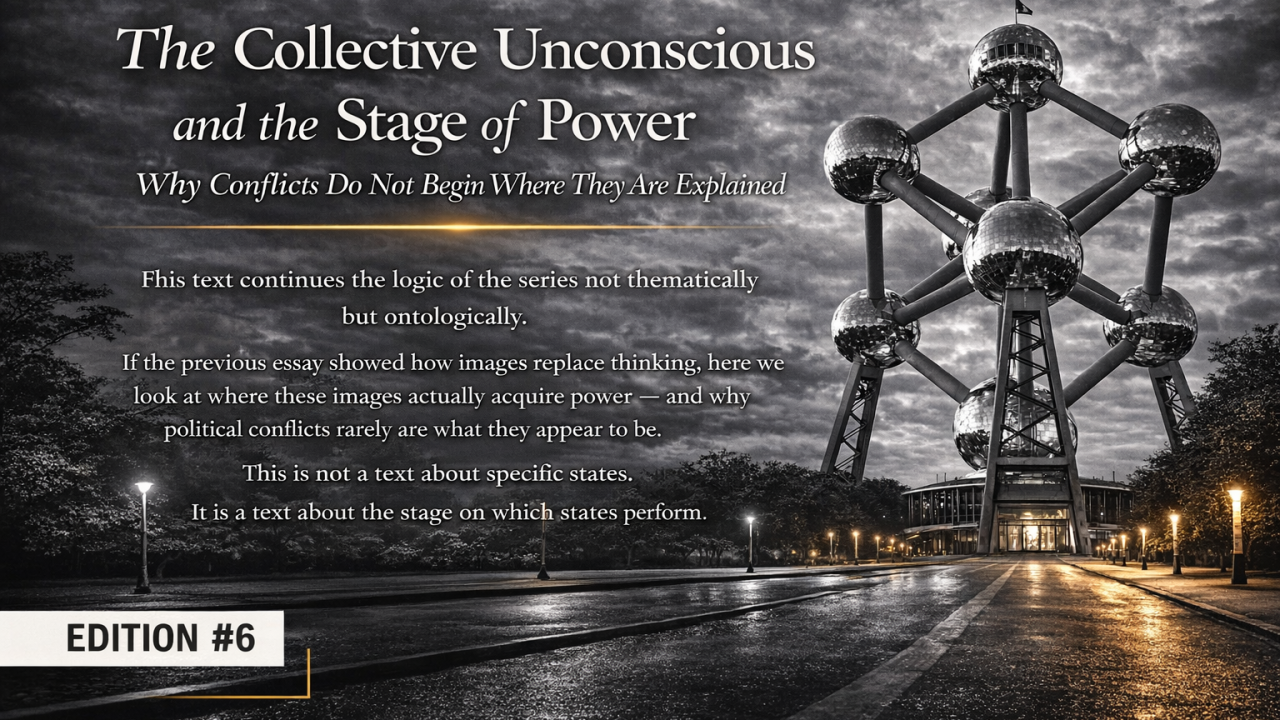
This text continues the logic of the series not thematically but ontologically. If the previous essay showed how images replace thinking, here we look at where these images actually acquire power – and why political conflicts rarely are what they appear to be.
This is not a text about specific states. It is a text about the stage on which states perform.
1. The Collective Unconscious Is Not a Metaphor
The collective unconscious is neither a poetic image nor mysticism.
It is a level of psychic reality at which individual motives are no longer decisive.
At this level operate:
- archetypal roles;
- historical traumas;
- unconscious patterns of repetition.
At this level, nations do not “make decisions.”
They reproduce structures that appear to them inevitable.
2. Power as a Stage Rather Than an Institution
We are accustomed to thinking about power through:
- positions,
- laws,
- institutions.
But psychologically power functions differently.
It exists as a stage on which archetypes are performed.
On this stage the same roles always appear:
- the Hero;
- the Enemy;
- the Victim;
- the Protector;
- the Traitor;
- the Savior.
It does not matter who formally occupies the seat of power.
What matters is which role they are allowed to play.
An archetype is fuel – but the fuel is poured into the tank by specific stations. Sometimes it is beneficial for power or elites to sustain the archetype of the Enemy, because it converts easily into loyalty, budget flows, and control over resources.
The collective unconscious becomes a political weapon when it is directed by those who possess administrative power.
3. Why Conflicts Cannot Be “Explained” by Facts
Facts operate at the level of consciousness.
Conflicts live at the level of identification.
When the collective unconscious is activated:
- arguments no longer persuade;
- logic is perceived as betrayal;
- doubt is interpreted as weakness.
At that moment any analysis that ignores the archetypal stage becomes intellectually correct but politically powerless.
4. The Archetype of War as a Mechanism of Stabilization
War is not only destruction.
Psychologically it often performs the function of stabilization.
It:
- removes internal contradictions;
- creates a clear division between “us” and “them”;
- allows difficult questions to remain unasked.
At the level of the collective unconscious, war becomes a way of avoiding transformation.
5. Why “Healthy Solutions” Fail to Appear
Rational solutions to conflicts are often known.
Yet they are not implemented.
The reason is simple and cold: they destroy the stage.
And the stage:
- holds identities together;
- supports power;
- gives meaning to roles.
To destroy the stage means leaving many people without a role.
And the psyche does not tolerate that.
6. Who Can Actually Change the Course of Events
Not the one who is louder.
Not the one who is more moral.
And not even the one who is more correct.
But the one who:
- sees the stage;
- does not merge with the role;
- does not live according to the automatism of archetypes.
This is not a mass position.
It is the position of the subject – the one who does not simply play but distinguishes.
The subject is not a caste of the enlightened. It is a mode of attention. Any person who, in the middle of an argument, suddenly asks themselves: “Why am I saying this right now? Whose role am I playing?” becomes, for a moment, a subject.
The only question is whether a political system can tolerate the widespread emergence of such a habit.
The subject does not smash the stage with the hammer of facts – that would only anger the actors.
Instead, the subject proposes another script.
If a nation is playing “The Besieged Fortress,” it is pointless to prove that there are no enemies. It is more effective to show that the fortress game is exhausting – and to offer another game instead: “The Open University” or “The Space Program.”
Conflict changes not by denying a role, but by tempting people with another one.
7. The Return of the Subject as a Political Threat
The subject is dangerous for the system not because it is radical.
But because it:
- does not need an enemy image;
- cannot be easily mobilized;
- does not automatically reproduce the script.
The subject does not destroy power.
It deprives it of its magic.
Conclusion
The collective unconscious is not evil.
It is depth.
But where the subject disappears, depth turns into fatality.
Thinking does not begin with choosing a side.
It begins with stepping off the stage.
And it is precisely there – in a cold, uncomfortable, non-ideological space – that the real possibility of change appears.
The collective unconscious is the soil. But whether poison grows from that soil or a tree of life depends on who cultivates it and how.
Thinking begins not with choosing a side, but with stepping out of the stage.
Yet real courage begins when, having stepped out of the stage, one returns to it consciously – not because there is no alternative, but because one has chosen this role as a temporary responsibility toward others.
The subject is not the one who escapes.
The subject is the one who plays while remembering that it is only a game – but plays responsibly.
Leave a Reply