
Editorial Note
This text continues the conversation begun in the previous essays of the series:
- Silence as the condition for the emergence of thinking;
- When Form Begins to Govern Meaning as an analysis of the mechanism of petrification.
Here the focus shifts one step further- to the moment when a system reaches its own limit, and only the return of the subject can restore its meaning.
Introduction: Signals We Ignore
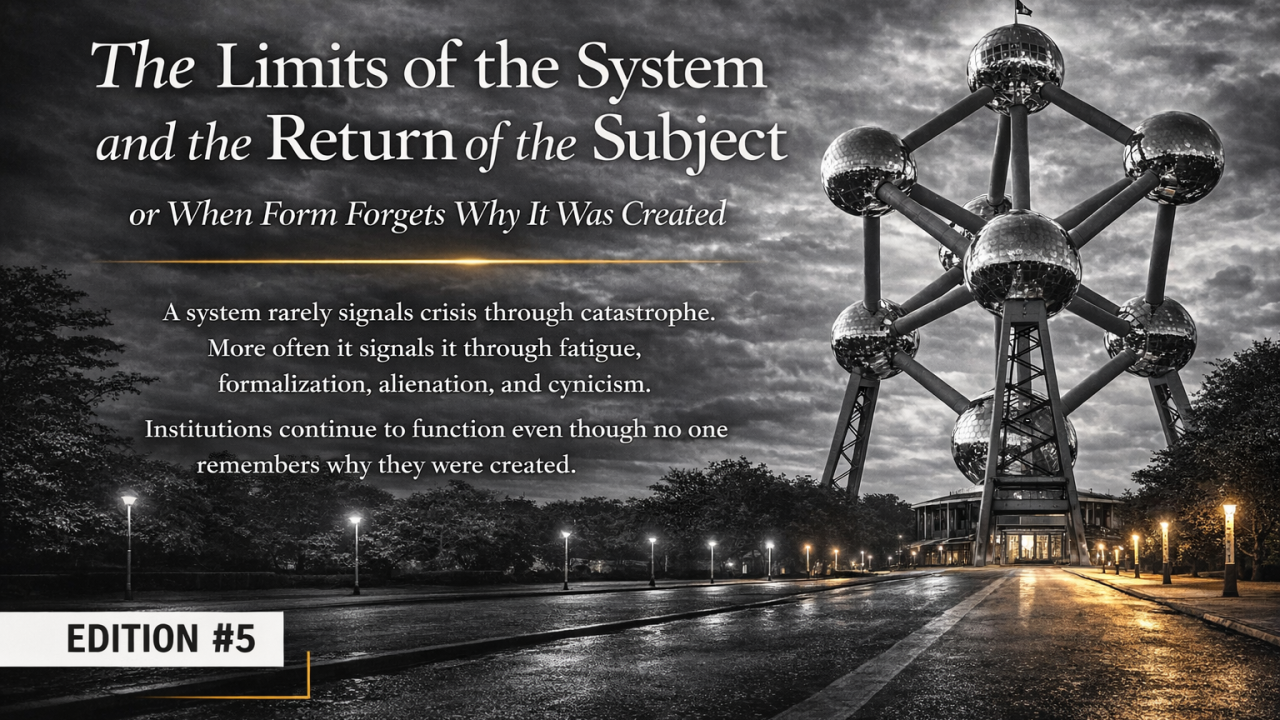
A system rarely signals crisis through catastrophe.
More often it signals it through fatigue. Formalization. Alienation. Cynicism.
Institutions continue to function even though no one remembers why they were created. Words turn into clichés, losing their meaning. People perform rituals without understanding why.
This is not a malfunction.
It is a signal of a limit.
The system has reached the edge of its own form. Beyond that edge there is only emptiness – or renewal.
1. What a Limit Is and How to Recognize It
A limit is not an ending. A limit is the place where form encounters what it can no longer contain.
In politics, the limit appears as the cynicism of elites – when decisions are made by inertia, without belief in their necessity. Parliaments vote, governments report, diplomats negotiate – yet everyone senses that the game is being played by rules that have long since lost their meaning.
In language, the limit appears as cliché – when words no longer carry experience but merely signal belonging to a position. “Democracy,” “freedom,” and “justice” become labels behind which nothing remains.
In the psyche, the limit appears as fatigue – when a person no longer feels the meaning of their actions yet continues performing them because “that is what one is supposed to do.”
In the previous essay we spoke about how form stops serving thought.
Here we see the consequence: a system that has lost its connection to reality begins to produce emptiness.
2. What Breaks in a System Without a Subject
When form becomes autonomous, it is not the structure that breaks.
What breaks is responsibility.
Because a system:
- does not doubt;
- does not hesitate;
- does not carry ethical risk.
It simply functions.
The subject, by contrast, is the place of doubt, of limits, of pause.
It is the one who can ask:
- Why?
- For whom?
- What price does this have?
When the subject disappears, decisions remain – but without anyone willing to be responsible for them.
Politics becomes management, ethics becomes instruction, and thinking becomes merely a position.
This is precisely what we observe today in bureaucracies, corporations, and even universities, where procedure has long replaced living presence.
3. Why the Limit Is an Invitation, Not a Verdict
A system at its limit has two possibilities:
- to petrify, finally turning into ritual;
- to open itself to the subject who can return the question.
A limit is not the end of a system.
It is an invitation to the return of the subject.
Here it is worth recalling another essay from this series – The Temptation of Another Role. There we argued that escape from a trap does not come through destroying form but through proposing another game.
The same applies to systems: the subject does not break them, but returns them to the original question:
Why are we here?
4. The Return of the Subject: Not Destruction but Restoration
To return the subject does not mean to destroy form.
It means to place a question within it again.
The subject:
- does not deny the system;
- does not romanticize chaos;
- does not demand absolute freedom.
Instead, the subject restores form to its original function: to serve thinking rather than replace it.
What does this look like in practice?
In politics: the return of the subject occurs when an official, instead of issuing a formal reply, assumes responsibility for a decision. When a politician risks their position rather than merely reproducing the party line.
In language: the return of the subject occurs when a writer or journalist refuses clichés and searches for words that correspond to their experience rather than the expectations of an audience.
In the psyche: the return of the subject occurs when a person pauses in the middle of automatic functioning and asks themselves:
What do I actually want?
It is precisely here that the space of ethics appears again – not as a code, but as the responsibility of a living person for their own decision.
And this returns us to the very first essay in the series – Silence as Ethical Resistance.
The silence we spoke of there is not merely a pause. It is the space in which the subject can hear themselves through the noise of the system.
5. Why This Matters Now
We live in a time of extraordinarily efficient systems:
- informational systems producing endless streams of content;
- political systems reproducing rituals without meaning;
- economic systems optimizing everything except human life;
- algorithmic systems where decisions are made by machines while responsibility dissolves.
They work quickly. Smoothly. Convincingly.
And precisely for this reason the question of the subject becomes critical again.
Because without it:
- thinking is reduced to position;
- responsibility to instruction;
- truth to formal correctness.
Artificial intelligence, algorithmic governance, and social scoring systems are tools.
But when they become systems that no longer require a subject, we enter a space where decisions are made — yet no one is responsible for them.
Conclusion
Form is necessary. Systems are inevitable.
But only where the subject does not disappear does thinking remain alive.
The limit is not the enemy of order.
The limit is the place where form may still remember why it was created.
And where we, pausing for a moment amid automatisms, can ask ourselves the only question worth answering:
Is this truly what I chose?
Because when this question disappears, we disappear with it.
Afterword for the Reader
This text is the fourth in a series that began with silence.
It offers no ready-made prescriptions.
It only reminds us of one simple thing: a system is a tool.
A tool cannot think for you.
It can only serve – or enslave.
The choice, as always, belongs to the one who is able to pause and ask the question.

Leave a Reply