
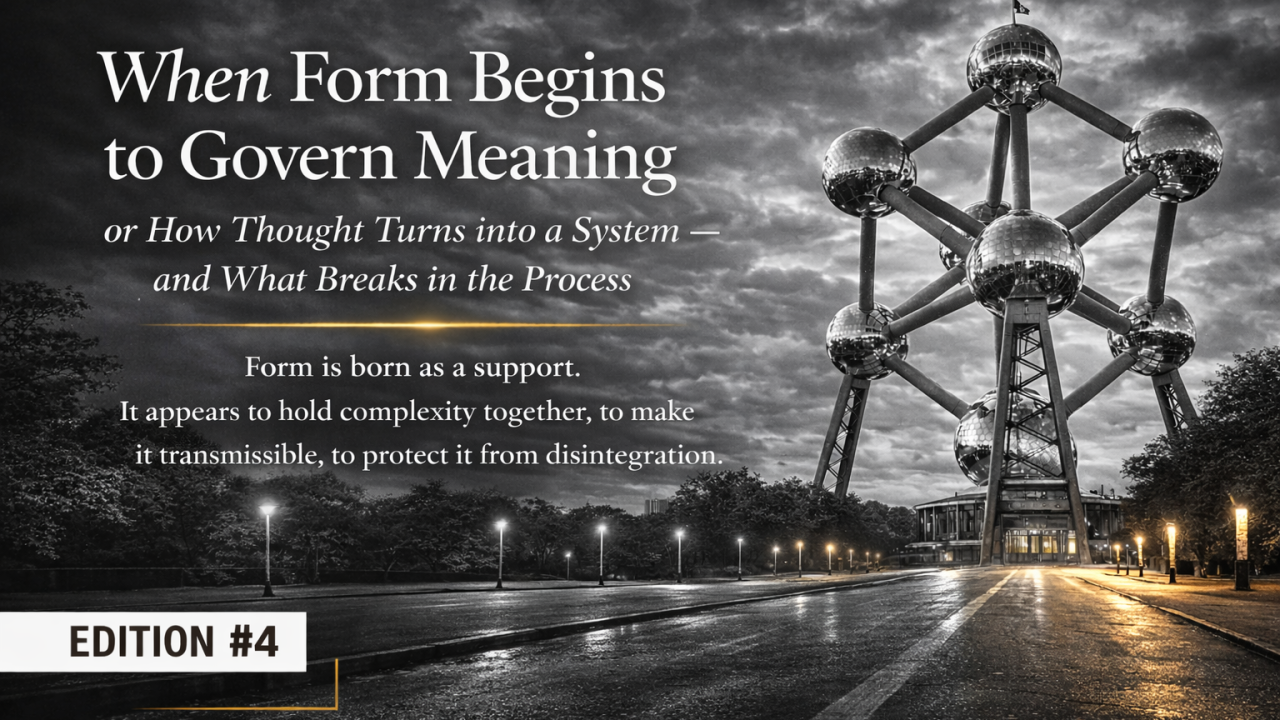
Form is born as a support. It appears to hold complexity together, to make it transmissible, to protect it from disintegration.
Language, rules, institutions, methods, roles – all of these once emerged as responses to real needs.
The problem does not begin when form appears. It begins when form forgets why it was created.
1. The Moment of Substitution
Form is always seductive. It promises stability, repeatability, control. And very quickly it begins to demand loyalty.
At that moment, an almost invisible shift occurs:
- thought no longer examines the form;
- the form begins to examine thought;
- questions turn into procedures;
- meaning becomes compliance.
At this point, form no longer serves meaning. It begins to guard itself.
2. How Thought Becomes a System
A system is thought that has stopped — but has not disappeared. It continues to move by inertia.
The signs of this shift are always similar:
- questions become unwelcome;
- complexity is perceived as a threat;
- context is replaced by instruction;
- answers are valued more than understanding.
A system does not lie. It simply no longer listens.
3. What Breaks First
The first thing that disappears is the subject.
- A person no longer thinks – they function.
- They no longer ask – they comply.
- They no longer take responsibility – they “follow procedure.”
Form is convenient precisely because it removes the burden of inner decision. But with that burden it also removes the capacity to become a source of action.
4. Control as a Substitute for Meaning
When meaning is lost, the system strengthens control.
This is its way of surviving.
What emerges instead is:
- regulation instead of thinking;
- loyalty instead of honesty;
- correct language instead of precision;
- fear of error instead of the search for truth.
Form begins to behave like an ideology – even if it once was only a method.
5. Why Systems Do Not Like Silence
Silence is dangerous for a system.
Because in silence a question appears: Why does this exist at all?
A system requires continuity. A pause exposes its contingency.
That is why:
- silence is perceived as a threat;
- reflection as sabotage;
- doubt as disloyalty.
6. Form as Necessity — and as Risk
This text is not about destroying forms.
Without them, neither language, nor society, nor knowledge would be possible.
But form requires a constant return to a question:
Are we still serving meaning – or have we begun to serve the structure itself?
A form that is never tested by silence will sooner or later begin to produce an empty order.

Leave a Reply