
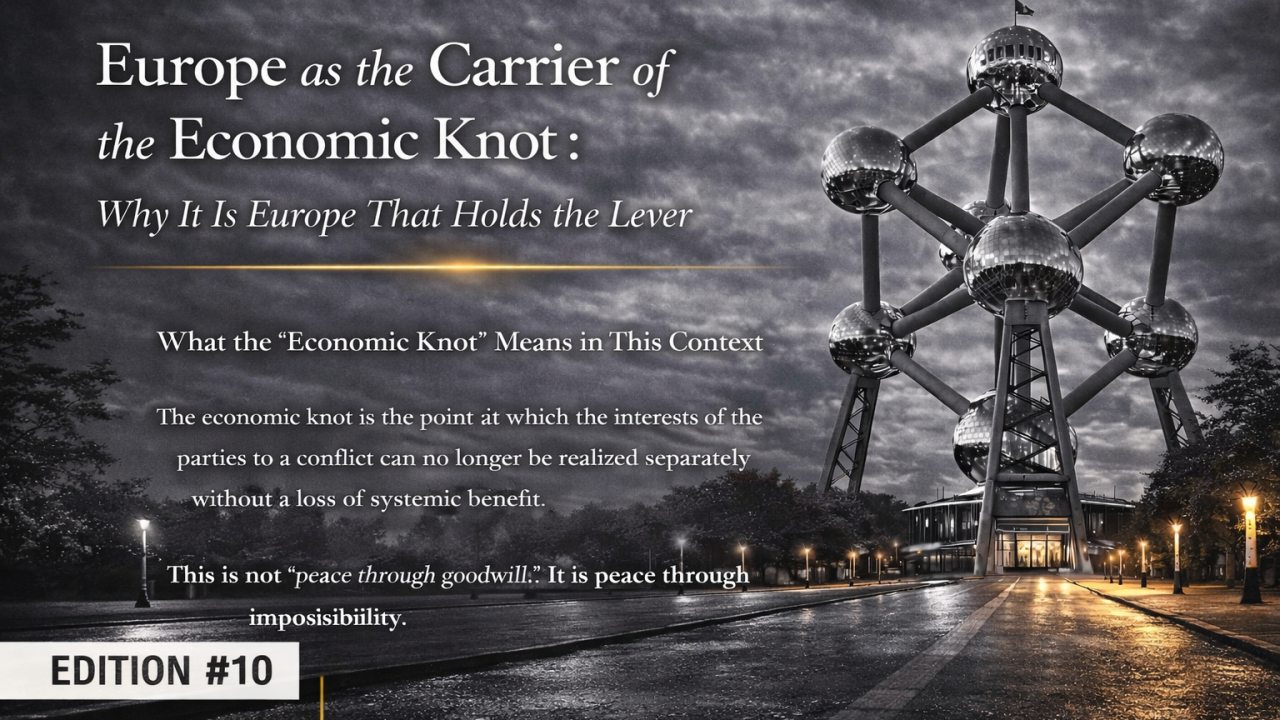
1. What the “Economic Knot” Means in This Context
The economic knot is the point at which the interests of the parties to a conflict can no longer be realized separately without a loss of systemic benefit.
This is not “peace through goodwill.” It is peace through impossibility.
The knot functions when :
- Profit becomes dependent on stability;
- Control over resources requires cooperation;
- Continuing the war becomes more expensive than ending it.
In the previous text, we identified three levels at which the knot is formed :
- The resource level (critical materials),
- The technological level (production chains),
- The financial level (access to capital and insurance).
It is precisely their intersection that creates the point at which war becomes unprofitable.
2. Why Europe – Not the United States, and Not the Parties to the War
Ukraine:
- Does not control financial flows,
- Does not determine the rules of access to markets,
- And remains in a position of dependency.
It is inside the conflict – and therefore cannot see the architecture.
Russia:
- Conceives of war as an element of identity and control,
- Is willing to pay an economic price for geopolitical subject hood,
- And has no interest in a knot that would reduce sovereign control.
It, too, is inside the conflict – and therefore cannot be the architect of an exit.
The United States:
Benefits from managed instability.
- The defense industry,
- Control over Europe,
- The weakening of competitors without direct involvement.
The United States does not require peace as a systemic condition – managed war is sufficient.
It is outside the conflict and does not bear the main burden of its consequences.
👉 Therefore, none of the parties to the conflict is the carrier of the knot.
But there is one actor in a unique position :
- Inside the system of consequences (migration, inflation, security),
- Yet outside the direct confrontation.
- That position makes it possible to see the architecture, rather than only the front line.
3. Why the European Union in Particular
Europe is the only system for which war is :
- An existential threat rather than an instrument;
- A factor of internal destabilization (economy, migration, radicalization);
- A direct blow to the postwar model of peace.
The key point is this :
- Europe cannot afford an endless war,
- Because it has no imperial buffer.
4. Where the Economic Knot Actually Lies
It does not lie between Ukraine and Russia.
It lies in the triangle :
Ukraine’s resources ↔ Europe’s infrastructure ↔ Access to global markets
More specifically :
- Critical minerals – titanium, lithium, rare earth elements. Without them, Europe’s green transition and aviation industry lose their resource base.
- Energy routes – not only gas, but also the future infrastructure of hydrogen and electricity that is meant to run through Ukrainian territory.
- Investment guarantees – the condition under which European business is willing to enter the region at all. Without stability, investment is impossible.
Postwar reconstruction – the largest construction project in Europe since the Marshall Plan. It could fuel the European economy for years, but it is impossible without stability.
None of the parties can activate this knot on its own. It is tied to Europe.
5. How the Knot Can Be Activated
Not through negotiations “about peace.” But through the repackaging of interests.
The mechanism is this :
- Europe constructs the postwar economic architecture in advance.
- This means creating a framework agreement on reconstruction and association,
- Open for signature already now,
- But entering into force only once security conditions are met.
This transforms peace from an abstract goal into a concrete economic asset, access to which is blocked by war.
Access to that architecture :
- Is impossible during active war ;
- Becomes possible only after stabilization.
War ceases to be an instrument – It becomes a blocker of profit.
Investors, insurance companies, and financial markets begin to exert pressure on the continuation of the conflict not because they are “for peace,” but because war blocks their profit.
That is the moment pressure emerges.
6. Why This Is Not a “Moral Position,” but a Structural One
Historically, Europe has not won wars. It has embedded conflicts into structures within which they lose their meaning.
That is how it worked :
- After the Second World War (coal and steel),
- In the creation of common markets,
- In turning former enemies into co-owners of a shared system.
Today, a new dimension is added.
The green transition makes Europe critically dependent on resources that Ukraine possesses. Strategic autonomy forces Europe to seek those resources not in China or Africa, but nearby – in Ukraine.
War blocks that autonomy – And this makes it unacceptable not only for moral reasons, but for existential ones.
7. Europe as a Potential Subject
In the previous text, we spoke about actors without will – structures that automatically reproduce war.
Within that scheme, Europe occupies a special place. It is not an automatism.
It has a choice :
- To remain a sum of national bureaucracies reacting to events,
- Or to become the bearer of a long-term will capable of reshaping the architecture itself.
The historical paradox is that right now Europe has a chance to become precisely that subject we have been speaking about since the beginning of this cycle – the one capable of pausing, of seeing the system, and of changing it rather than merely functioning within it.
Conclusion
Europe is not a judge. Not a savior. Not a hero.
It is the carrier of the form into which the conflict may be forced to enter.
Not through persuasion. But through structural inevitability.
That is why the economic knot does not lie on the front line – It lies in systems stronger than the front line itself.
But those systems do not function automatically. They must be activated by the one who sees wholeness where others see only fragments.
Europe has a chance to become that architect.
The only question is whether it has enough silence to hear its own long-term will – and enough courage to act not as a function, but as a subject.
Leave a Reply