
Editorial Note
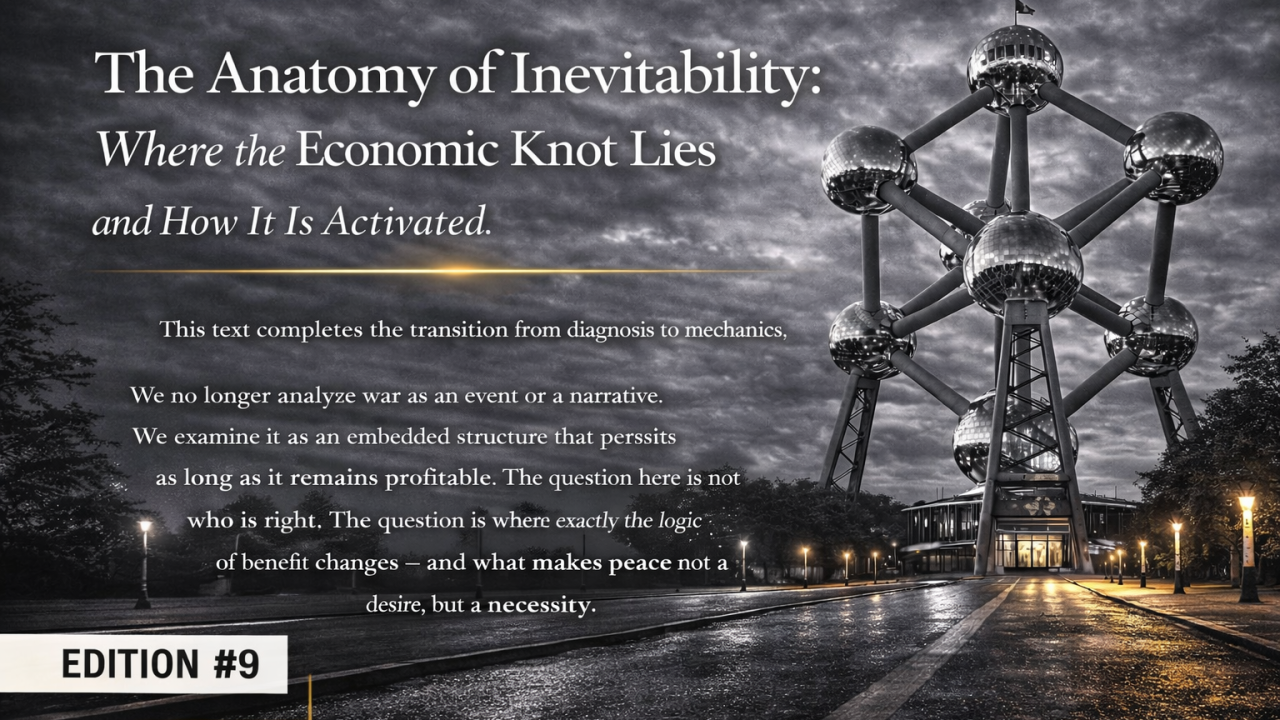
This text completes the transition from diagnosis to mechanics.
We no longer analyze war as an event or a narrative. We examine it as an embedded structure that persists as long as it remains profitable. The question here is not who is right. The question is where exactly the logic of benefit changes – and what makes peace not a desire, but a necessity.
1. Where the Economic Knot Actually Lies
The economic knot does not lie between the parties to the conflict. It lies above them. It is a fundamental mistake to search for the breaking point:
- on the front line;
- in negotiations;
- in shifts of rhetoric.
The knot forms where the conflict:
- intersects with global economic flows;
- begins to affect the stability of systems that are not direct participants in the war;
- creates risks for the long-term interests of a broader level.
In other words, the knot lies at the intersections of dependencies, not at the points where the sides collide.
Imagine a sheet of paper on which children are drawing a war. They see the front line, the cannons, the flags. But the sheet lies on a table. And the table is the economic knot. If the table disappears, the sheet falls.
The war ends not because the children reached an agreement, but because the surface on which they could draw has vanished.
2. The Three Components of the Knot
An economic knot emerges only when three levels of dependency converge.
2.1. The Resource Level
This is not simply about raw materials, but about resources that are:
- geographically limited;
- critical for both civilian and military technologies;
- embedded in global chains of processing and financing.
Control over them is never sovereign. It is always distributed.
Example: Ukrainian titanium, essential for aircraft production in Europe, or rare earth metals that power global electronics. Their extraction and logistics become not merely military targets but factors of stability for industries far removed from the front.
2.2 The Technological Level
No modern state possesses a complete technological cycle:
- components;
- software;
- equipment;
- infrastructure.
When war begins to disrupt these chains, it moves beyond the boundaries of a local conflict and becomes a systemic risk.
Example: the dependence of Russian weapons systems on microchips manufactured in countries not involved in the war. Once access to these technologies is blocked, the military machine begins to suffocate – not from a lack of shells, but from a lack of silicon.
2.3 The Financial Level
The least visible – yet decisive.
Prolonged war requires:
- liquidity;
- access to financial markets;
- manageable risk.
When war:
- increases the cost of capital;
- complicates financial settlements;
- alters investment expectations,
the financial system begins to resist the continuation of conflict – not politically, but mathematically.
Example: rising insurance premiums for vessels crossing the Black Sea block exports not only for the warring parties but also for neighboring countries. The London insurance market, far from the trenches, begins to dictate the conditions under which war becomes too expensive for global trade.
3. How the Components Work Together
These three levels never exist in isolation.
They function as a system:
- resources cannot be extracted without technology;
- technology cannot operate without financing;
- financing does not flow where resources cannot be secured.
The knot tightens precisely where all three loops converge at a single point. At that moment, war ceases to be a local affair. It becomes a problem of global architecture.
4. Why the Knot Is Invisible from Within the War
Participants in the conflict see:
- losses;
- mobilization;
- rhetoric;
- symbols.
They do not see:
- movements of capital;
- changes in insurance pricing;
- long waves of investment;
- strategic shifts in global supply chains.
This is why the decisive moment never appears as the result of the war’s internal logic. It arrives from a level the war itself does not control.
5. What “Activation” of the Knot Means
The activation of an economic knot is not an event or a gesture. It is a process of reconfiguration.
The knot is activated when:
- continuing the war becomes more expensive than stopping it;
- instability begins to threaten adjacent systems;
- risks exceed acceptable thresholds for key economic actors.
This is not pressure in the direct sense. It is a redistribution of incentives.
Example: sanctions against Iran did not immediately halt its nuclear program. But when they cut the country off from the global SWIFT financial system and made large-scale oil sales impossible, a configuration emerged in which negotiations became the only rational option.
The knot was activated not by moral condemnation, but by the loss of access to the global economy.
6. Who Is Capable of Activating the Knot
Not the parties to the conflict. And not those who speak the loudest.
The knot is activated through:
- control over flows rather than territories;
- management of access rather than rhetoric;
- shifts in the architecture of benefit rather than positions.
It is always the action of a broader system that:
- has no interest in identity-based wars;
- thinks in long cycles;
- responds to risk rather than to images.
Who belongs to this system?
Not abstract “capital,” but very concrete institutions:
- central banks setting interest rates;
- Lloyd’s insurance markets determining the price of risk in global trade;
- the International Monetary Fund opening or closing access to financing;
- pension funds unable to invest in high-risk zones;
- boards of transnational corporations restructuring supply chains.
They do not meet in a single room. They meet in a single equation.
Each actor pursues its own interests – risk minimization, profit stability, predictability of costs.
But when these interests converge, they create a field in which war can no longer breathe.
7. The Temporal Dimension of the Knot
Activation of the knot is not instantaneous. It unfolds in time.
Three phases can be distinguished:
- Latent phase – dependencies already exist but are not yet recognized as critical. War continues, though the first cracks in global chains have already appeared.
- Tension phase – the cost of continuing the conflict begins to exceed its benefits for key external actors. Targeted restrictions, sanctions, and insurance precedents emerge.
- Phase of inevitability – the system can no longer absorb the risks. Financial and technological flows contract sharply. War loses its material foundation.
The key question is not only where the knot lies, but when it tightens.
History offers many examples where the window of opportunity was missed and conflicts froze for decades.
Because a knot that does not tighten in time begins to attract new interests – actors for whom instability becomes the only source of survival.
They preserve the conflict, making it permanent.
8. Identity Resistance: Why the Knot Does Not Guarantee Peace
Even when the economic logic of war collapses, archetypes continue to live. The Hero does not want to become unemployed. The Victim is unwilling to relinquish their status. The Enemy must remain the enemy – otherwise the entire identity built around it loses meaning.
For this reason, activation of the economic knot is a necessary but not sufficient condition for peace. It creates a space in which peace becomes possible. But filling that space is a task of a different order.
The economic knot makes the old identity expensive. It does not create a new one. It merely closes the old account. At that moment another problem appears – the temptation of another role.
Peace requires not only financial decisions but imagination. People will not abandon the role of the Hero simply because it has become unprofitable. They must be offered a role that is more compelling.
The economic knot destroys the old stage. But a new stage must be built – and it must be more attractive than war.
Conclusion
The economic knot is not a place of compromise. It is the place where war ceases to function as an instrument.
Those who see the knot do not work with emotions or slogans. They work with the architecture of reality.
They understand that peace will arrive not when the sides understand each other, but when:
- insurance companies refuse to cover risks;
- investors withdraw capital;
- technological chains break;
- the financial system says “enough.”
And it is precisely there, where this architecture shifts, that the real space for peace first appears. A space in which it becomes possible to pause. And in that pause – to hear not the cannons, but silence.
That same interval from which genuine thinking begins.

Leave a Reply