
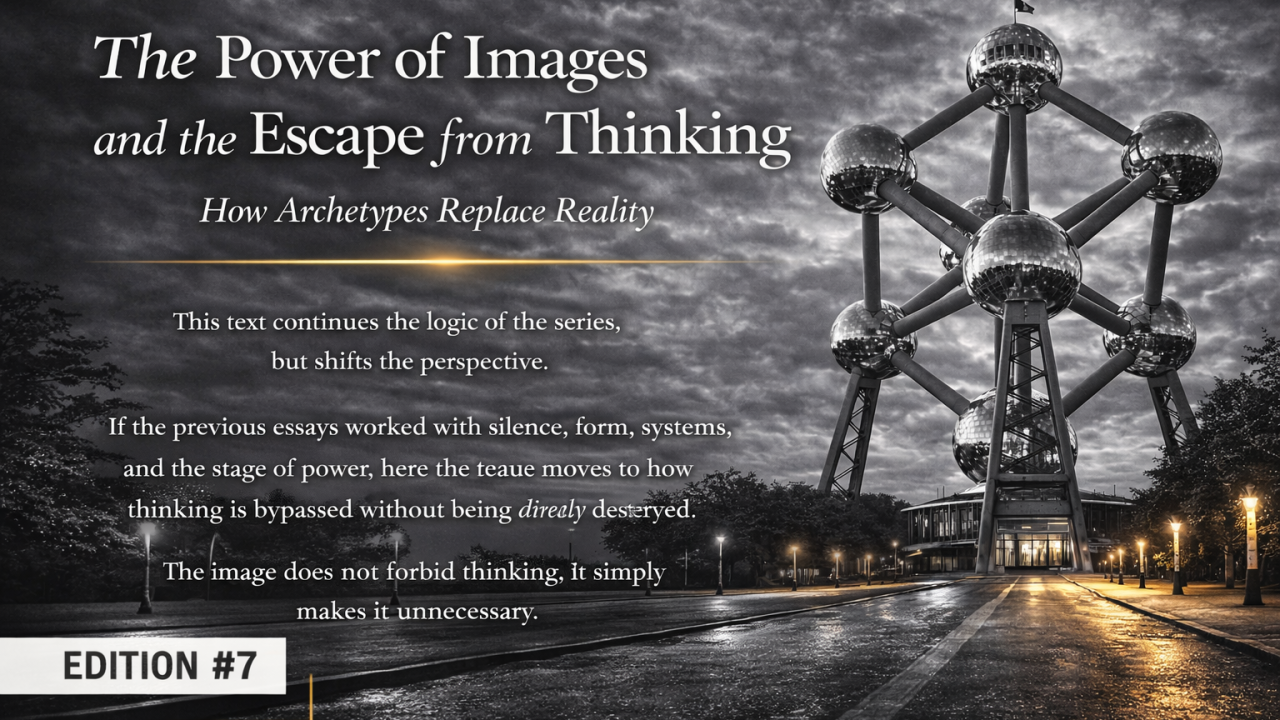
Editorial Note
This text continues the logic of the series, but shifts the perspective.
If the previous essays worked with silence, form, systems, and the stage of power, here the focus moves to how thinking is bypassed without being directly destroyed. The image does not forbid thinking. It simply makes it unnecessary.
1. The Image as a Shortcut
The human psyche is not neutral toward complexity. It seeks economy of effort. An image is the shortest path between reality and reaction.
Unlike a concept, an image:
- does not require verification;
- does not demand time;
- does not ask questions.
It triggers.
That is why images almost always have an advantage over arguments, and an emotional scene over structural analysis.
- A concept is tested by truth.
- An image is tested by recognition.
- It does not need to be true – it only needs to feel familiar.
2. The Archetype as an Energetic Container
An archetype is not an idea and not a symbol in the ordinary sense. It is a psychic form that activates experience without passing through conscious reflection.
When the following figures appear in political or cultural space:
- the Savior,
- the Enemy,
- the Traitor,
- the Mother,
- the Victim.
the psyche reacts faster than thinking can intervene. These are the same figures we have already seen on the stage of power. They are not chosen – they are activated.
An archetype does not lie. It simply does not ask permission to be precise.
3. When the Image Begins to Rule
The problem does not lie in archetypes themselves. They are inevitable.
The problem appears when the image:
- replaces analysis;
- substitutes for reality;
- becomes sufficient.
At that moment thinking is not destroyed. It is used as decoration. A person believes they are thinking, while in fact they are only rationalizing a reaction that has already occurred.
4. Escape from Thinking as Psychological Protection
Thinking is tension.
It requires us to:
- hold contradictions;
- accept uncertainty;
- delay conclusions.
An image releases us from this burden.
It provides:
- instant identification;
- moral clarity;
- a sense of belonging.
This is why the escape from thinking is often experienced not as degradation, but as relief.
5. The Politics of Images
Modern power rarely coerces. It enchants. It does not argue – it shapes a field in which arguments are no longer needed.
Images:
- organize loyalty;
- define whom to love and whom to hate;
- replace complex causes with simple explanations.
Within such a field thinking is not forbidden. It simply becomes unnecessary. Yet today the magic of power has acquired a new instrument – the algorithm.
Social networks do not create images from nothing. They calculate which image you are ready to consume and return it to you – now presented as objective reality.
What you see is not the world, but a polished reflection of your own archetypes.
This is not propaganda in the old sense. It is a mirror pretending to be a window.
6. What Is Lost
When images fully occupy the space:
- distance disappears;
- responsibility dissolves;
- the ability to change one’s position fades.
What disappears first is distance – that same silence between stimulus and reaction we spoke about at the beginning of this series.
Without that distance there is no choice, only automatism.
A person no longer has time to ask themselves – they have already answered through the image.
A person no longer asks: “Is this true?”
Instead they ask: “Is this my image?”
7. The Return of Thinking: Not a Struggle but a Distinction
Thinking does not defeat images. It distinguishes them.
The question from which everything begins is simple and dangerous:
What exactly in me is reacting right now? Not who is guilty. Not who is right.
But which archetype has been activated – and why.
It is here that the chance to restore the subject appears.
But a subject who has learned to distinguish archetypes within themselves inevitably begins to see them in the public space as well.
They begin to notice where people speak – and where images speak through people.
At that moment the person ceases to be a spectator.
They begin to see the stage.
And to recognize the stage means to deprive it of its power over oneself.
Conclusion
Images will always exist. Archetypes will not disappear. But thinking begins at the moment when the image stops being the final word.
Escape from thinking is not weakness. It is a human temptation. But responsibility begins where we refuse to live only through images and risk thinking again.
To think means to stop where others run after an image. To return to oneself the silence that algorithms have learned to fill before we even noticed it.
And in that pause to encounter not yet another image of oneself but oneself.
Leave a Reply