
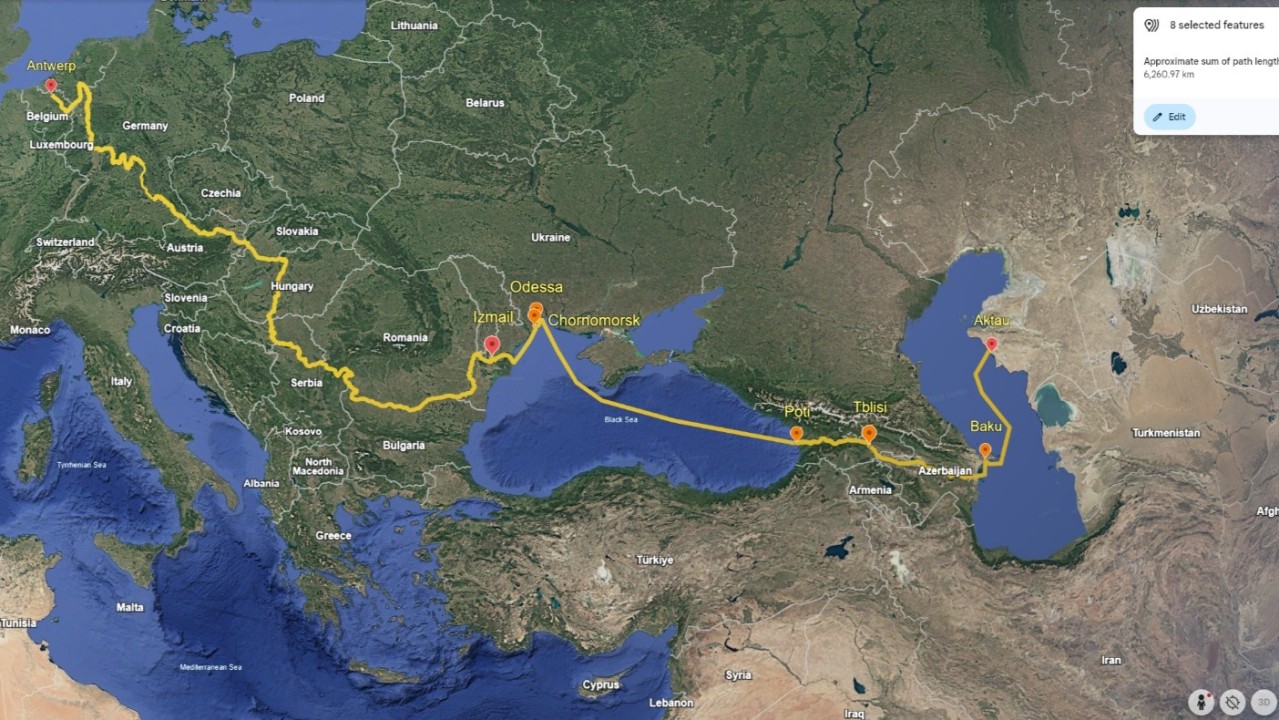
This is how Jean Monnet and Robert Schuman once thought about Europe.
They did not begin with diplomacy. They began with coal and steel. Not declarations. Not summits. Not political manifestos. An economic system.
The European Coal and Steel Community looked, at first glance, like a technical industrial arrangement. Yet it gradually transformed the logic of European conflict and became the foundation of what we now call the European Union.
Today, Europe may be standing before a similar moment.
While the world is watching the Middle East, another reality is emerging on Europe’s eastern flank.
Not political. Not military. Infrastructural.
On February 9, 2026, in Brussels, officials met in the QUAD format – Ukraine, the European Commission, Romania, and Moldova – to discuss the security of Danube ports.
On February 12, 2026, the shareholders of the Port of Constanța approved a deal originally signed on December 31, 2025: Romania acquires 100% of the operator of the Port of Giurgiulești, Moldova’s only seaport.
This is not a marginal asset.
Giurgiulești covers 55 hectares at the mouth of the Danube. More than 70% of Moldova’s waterborne exports and imports pass through it. Romania is set to invest more than €24 million in modernization.
Romania’s Minister of Transport put it plainly:
“This is not just a transaction. It is the consolidation of the strategic Danube–Black Sea corridor.”
That sentence matters more than it may seem. Because on Europe’s map, a new axis is gradually becoming visible:
Central Asia → Caspian Sea → Caucasus → Black Sea → Ukraine → Danube → Europe → Antwerp
At first glance, this may look like ordinary transport policy. Ports. River depth. Customs procedures. Ownership structures. Investment plans.
But history teaches something else: sometimes logistics reshapes politics faster than diplomacy.
If Central Asian resources – uranium, copper, grain, rare earths, strategic materials – begin moving toward Europe through the Black Sea and the Danube, rather than through routes shaped or constrained by Russia, then more than transport will change.
The architecture of interests will change.
And when the architecture of interests changes, the logic of conflict changes with it.
This is why the developments on the Lower Danube should not be read as isolated technical events. They are part of a wider geo-economic reordering already underway.
In 2025, Ukraine’s Danube ports – especially Izmail and Reni – handled 8.9 million tons of cargo.
This is no longer theory. It is no longer a map drawn in policy papers. It is an emerging geo-economic reality.
And within this reality, new centers of gravity may appear.
Not capitals of politics. Capitals of logistics.
If the Black Sea–Danube corridor takes shape, Antwerp may become more than a North Sea port. It could become the western gateway of a new Eurasian economic artery.
And if that happens, then the small Ukrainian city of Izmail may turn out to be closer to Europe’s future than many diplomatic summits.
Infrastructure does not guarantee peace. But it creates gravity. And gravity, over time, creates orbits.
Seventy years ago, Europe learned to build peace through the management of strategic materials.
Today, it may have to learn again – this time through corridors, ports, river systems, and the reorganization of continental logistics.
📌 In my new article, I explore how the Black Sea–Danube corridor could reshape Europe’s economic and strategic future. 👉 Link in the first comment
Question: Do you believe logistics can change politics faster than diplomacy?
#Geopolitics #Europe #Ukraine #Romania #Moldova #EU #Danube #BlackSea #Infrastructure #Logistics #CentralAsia #FutureOfEurope #BlackSeaDanubeArc
P.S. The image shows the Black Sea–Danube Arc – the route that could connect Central Asia with the heart of Europe.

Leave a Reply