
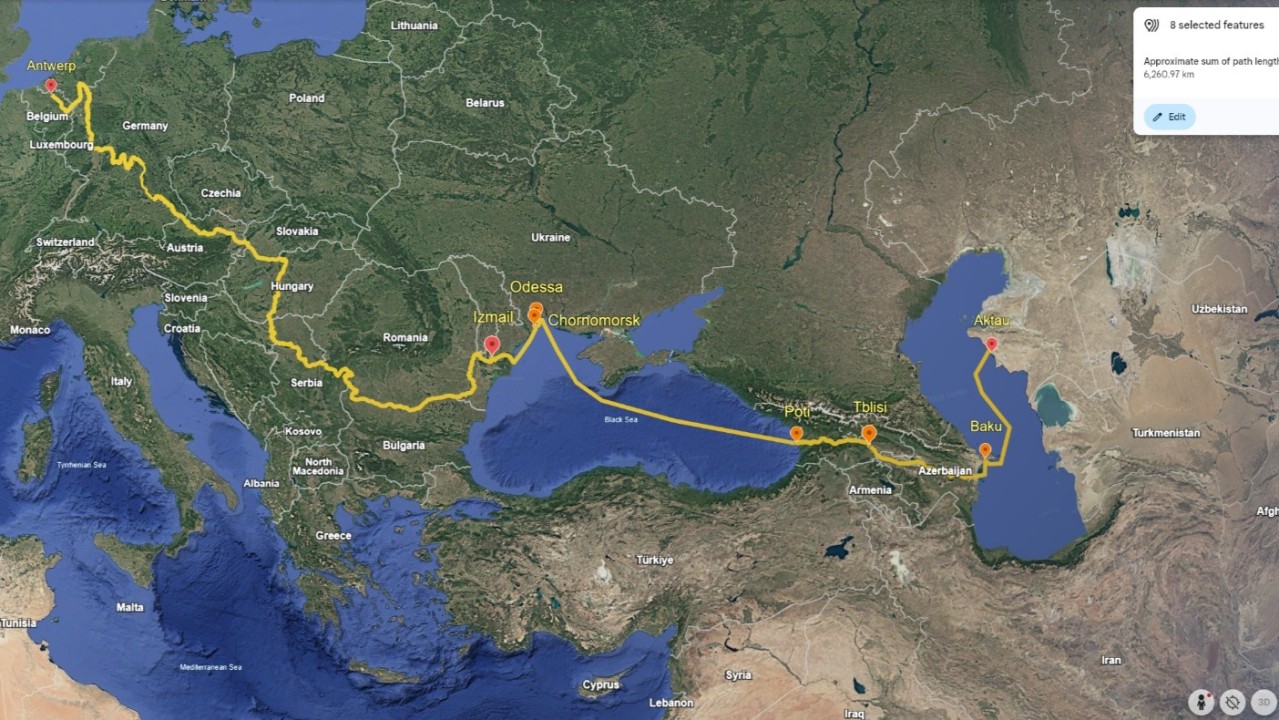
While European leaders react with shock to the attacks on Iran, and Washington and Tel Aviv challenge international law, a different reality is taking shape on Europe’s eastern flank – quiet, technical, yet potentially far more consequential. The Black Sea–Danube corridor will not stop today’s bombs. But it can create an architecture in which tomorrow’s conflicts lose their economic meaning.
BRUSSELS – On a gray morning in early 2026, a convoy of European officials stopped on the banks of the Danube in the Ukrainian city of Izmail. The air smelled of diesel, damp grain, and river water – the same scents that have accompanied trade in this part of Europe for centuries. The captain of a local tugboat, a man with a face weathered by wind and time, looked at the visitors from Brussels with a mixture of hope and skepticism.
“It used to be full of life here,” he said. “Then came the war. And after that, the silence.”
His words are more than a local story. They are a metaphor for the entire geo-economic tragedy of the continent.
At first glance, the visit of the European commissioners to a small city on the lower Danube may seem like ordinary transport policy: technical questions, fairway depth, port capacity. But in wartime, even technical decisions can have strategic consequences. Sometimes a new geo-economic structure begins to take shape precisely in such places – where geography meets political will.
Geography that determines politics
Political systems change. Empires disappear. Geography remains.
Ukraine’s territory lies at the crossroads of three major transport systems:
- the maritime space of the Black Sea;
- the steppe corridor between Europe and Central Asia;
- the river transport network of Central Europe.
To understand the depth of this phenomenon, one must look at the map through the eyes of a historian. Long before modern states emerged, the Vikings traveled along this water artery “from the Varangians to the Greeks.” They dragged their longships overland between the Dnipro and the Lovat in order to reach the Black Sea from the Baltic. They traded in furs, honey, and slaves. Today we want to move uranium, copper, and grain. The state of Kyivan Rus arose precisely as a trading center at this crossroads. Technology has changed. The logic has not.
But it was not only medieval merchants who understood this logic. At the beginning of the twentieth century, it was formulated by the British geographer Halford Mackinder – the man who first viewed the planet as a single interconnected chessboard.
In 1904 he published The Geographical Pivot of History, and later formulated the Heartland theory. Its core idea is simple and ruthless: whoever controls Eastern Europe gains access to the “heart of the world”; and whoever controls that heart rules the “World-Island” – Eurasia – and ultimately the world itself.
For Mackinder, Eastern Europe was not merely a territory but a gateway to the planet’s greatest reservoir of resources and power. He warned that if this gateway were not shielded by a belt of independent states, then Russia, Germany – or both together – would hold the key to world domination.
His ideas did not remain confined to academic studies. They became an intellectual weapon. And today, more than a century later, we can see how that geographic logic manifests itself in the actions of those who refuse to recognize Ukraine’s right to exist.
The imperial narrative of the Kremlin
In Russian political culture, Ukraine holds a special significance.
In the Kremlin’s narrative, Kyiv is presented as the historical center of a common civilization. But behind that historical rhetoric lies a far more pragmatic logic – precisely the same one Mackinder once described.
- Control over transport flows.
- Control over the Black Sea space.
- Control over the land corridor between Europe and Asia.
That is why Ukrainian territory again and again becomes the focal point of geopolitical conflicts.
Moscow understands economic geography extremely well. Russia’s strategy after 2022 consisted not only in conquering territory, but in closing airspace, blocking ports, and destroying logistics infrastructure. This is a war against trade. While Europe still thinks in categories of borders, Russia thinks in categories of flows.
The economic knot
Wars do not end only through military victories. Sometimes they are replaced by another structure of interests.
In international politics, there is the concept of the economic knot – the point at which the interests of different actors become so deeply intertwined that stability becomes more profitable than conflict. The classic example is the initiative of the French statesman Robert Schuman, which led to the European Coal and Steel Community. Economic integration changed political incentives.
That is no guarantee of peace. But it does change the logic of the system.
- A corridor already taking shape
- A new transport system is already emerging across Eurasia.
It is known as the Trans-Caspian International Transport Route – the Middle Corridor.
Its geography looks like this:
Central Asia
→ port of Aktau (Kazakhstan)
→ Caspian Sea
→ port of Baku (Azerbaijan)
→ Baku–Tbilisi railway
→ Georgian ports of Poti or Batumi
→ Black Sea
→ Europe.
Kazakhstan plays a special role in this system. The country is one of the main suppliers of strategic raw materials for the green economy – uranium, copper, and rare metals.
For the European Union, access to those resources has become a strategic issue since 2022.
The numbers speak for themselves: the EU imports about 30% of its uranium from Kazakhstan. This is a critical resource for energy independence. Today, most of that uranium still travels via Russia — across Russian territory or under the control of Russia’s Rosatom. That is not mere dependency. That is hostage-taking. Every kilogram of Kazakh uranium that can move via the Black Sea and the Danube is a kilogram Russia can no longer use as leverage.
But there is also another geo-economic logic.
The Black Sea–Danube knot
If the Middle Corridor is connected to Europe’s river system, a new configuration emerges.
The route would then look like this:
Central Asia
→ Aktau
→ Baku
→ Tbilisi
→ Poti / Batumi
→ Black Sea
→ Odesa / Chornomorsk
→ Reni / Izmail
→ Danube
→ Budapest
→ Vienna
→ Regensburg
→ Rhine
→ port of Antwerp-Bruges.
This is not a theoretical sketch. The ports of the Danube region have already proven their capacity: in 2022, in the middle of war, they tripled their throughput – from 5.5 to 16.5 million tons. Izmail handled 8.9 million tons, Reni 6.8 million tons. More than 6.5 million tons of that was grain that fed the world when other routes were blocked.
Let us look at costs. Today, a container traveling from China to Europe via Russia carries enormous political risks. Via Turkey, the route is longer and more expensive. The Black Sea–Danube route could become a golden middle way: it bypasses Russia while giving direct access to the heart of Europe. According to preliminary expert estimates, it could be 15 to 20% cheaper than alternative routes, provided logistics are well organized and customs barriers are reduced.
But there is one detail that cannot be ignored. Today, a significant share of Ukrainian cargo passes through the Romanian port of Constanța. And that is exactly where a bottleneck emerges: Constanța’s capacity is limited, the port is overloaded with its own grain flows, and queues there have become almost normal. That makes the development of direct Danube routes into Central Europe not merely convenient, but strategically necessary.
In this system, Ukraine becomes a bridge between the Black Sea and the internal market of the European Union. Between the resources of the Caspian region and the logistical brain of Antwerp.
The logistics model of Antwerp
The port of Antwerp-Bruges is one of the largest logistics hubs in the world. Its strength lies not only in the seaport.
Its strength lies in the system:
- container terminals;
- rail corridors;
- river logistics;
- inland dry ports.
It is precisely this intermodal model that allows goods to move quickly between sea, rivers, and rail.
Antwerp is not just a port. It is the brain of European logistics. And if that brain is connected to a new artery, Europe will gain not simply another route, but a full-fledged system linking the Caspian Sea to the North Sea.
The European transport architecture
Within the transport policy of the European Union, such integration already has an institutional basis. It is known as the Trans-European Transport Network (TEN-T). The Rhine and the Danube are already part of it.
The integration of Ukrainian ports on the Black Sea and the Danube into this system could create a new transport axis between Central Asia and the internal market of the European Union.
The green dimension
Europe’s green transition is changing the logic of infrastructure. River transport emits significantly less CO₂ than road transport.
In the future, this system could be linked to new energy infrastructure – hydrogen pipelines, electricity grids, and digital logistics platforms.
Imagine the Danube ten years from now. Inland vessels no longer run on diesel, but on hydrogen produced locally – from floating wind farms in the Black Sea. Wind power feeds the port cranes of Izmail. This is not science fiction. These are technologies that already exist. The only question is whether Europe today has enough political will to invest in them and reap the rewards tomorrow.
Food security
There is another factor that makes this corridor strategic: global food security. Ukraine is one of the world’s largest grain exporters. Since the beginning of the war, the Danube ports – Reni, Izmail, and Ust-Dunaisk – have become crucial gateways for Ukrainian grain exports. Combined with Europe’s inland waterways, this system can become a stable food corridor between the Black Sea and world markets.
An advantage for all: why everyone needs this
Geopolitics is always about interests. Dreams do not build corridors. Money, raw materials, and a sense of mutual benefit do. So let us look at the map through the eyes of those who must make decisions.
For Romania
Constanța is today a strong port, but often operates below its true potential. The Black Sea–Danube corridor would make Constanța not an endpoint, but a transit hub. Romanian companies would gain a share in Ukrainian transshipment. Romanian farmers would gain stable access to the markets of Moldova and Central Asia. And above all, Bucharest would become a key to Europe, not merely a border guard.
For Hungary
Hungary has no access to the sea. That is its historical trauma. But the Danube flows through Budapest. The Black Sea–Danube corridor gives Hungary something it has lacked for centuries: a direct river connection to the Black Sea. Hungarian factories would receive Kazakh ores without intermediaries. Hungarian grain could sail to Asia without having constantly to look toward the Bosporus.
For Orbán, who likes to speak about sovereignty, this is the best form of sovereignty – economic sovereignty.
For Kazakhstan
Astana today is trapped between two giants. The route via Russia means dependency. The route via Iran means sanctions.
The Black Sea–Danube corridor is a third way.
Access to Europe without political hostage-taking.
Kazakh uranium, copper, and rare metals would receive a green light to the European market. For President Tokayev, who balances between great powers, this means strategic room for maneuver.
For Antwerp
Antwerp is not just a port. It is the mind of port logistics. Control over Europe’s eastern gateway means control over the cargo flows of the future. When Kazakh resources pass through Izmail, they do not go through competitors. Antwerp would then gain not only cargo, but influence over European logistics as a whole.
For Azerbaijan and Georgia
Baku and Tbilisi have already invested billions in the Middle Corridor. A Black Sea–Danube branch would turn those investments not into a dead end, but into a transit hub. They would sell not only oil. They would sell geography.
The shadow of the Kremlin and other risks: what could prevent this
Every realistic analysis begins with the recognition of risks. Optimism without sobriety is naïveté. And naïveté costs lives in geopolitics.
The first challenge is Russia. The Kremlin will not sit idle while a new Silk Road grows without it. The pressure tools are well known: cyberattacks on port infrastructure, disinformation campaigns about the “ecological threat” of shipping, pressure on Kazakhstan through shared borders and economic dependency. The worst-case scenario is a direct attack on civilian vessels in the Black Sea under a foreign flag. That would destroy insurance coverage and immediately paralyze the corridor. The attacks on the ports of Reni and Izmail in July and August 2023 proved that this threat is very real.
The second challenge concerns the straits. The Bosporus and the Dardanelles remain the only exit from the Black Sea. The Montreux Convention guarantees the free passage of merchant vessels – a fundamental right that Turkey consistently respects. But administrative procedures, inspections, weather conditions, and traffic management can cause delays. Moreover, Turkish ports – Istanbul, Ambarlı – are direct competitors to the Danube routes. Ankara has its own ambitious plans to become a logistics hub, and in that competition it will use every available instrument short of an open blockade. Turkey is not an enemy, but neither is it a selfless ally.
The third challenge is internal. Within the EU, there are forces that have no interest in a new strong eastern gateway. The ports of Hamburg, Rotterdam, and Marseille also compete for cargo flows. Lobbies of older routes will resist investment in Danube infrastructure. And Hungary, though it would benefit from the corridor, remains at the same time the most pro-Russian voice within the EU. Will Budapest become a “Trojan horse” that slows the project in exchange for cheap gas from TurkStream?
And finally there is a fourth challenge: infrastructural bottlenecks. The Romanian port of Constanța, through which a significant share of Ukrainian exports passes today, is overloaded by its own cargo flows. A shortage of pilots on the Danube limits capacity, especially at night. Rail links to Izmail, according to 2023 data, suffered waiting times of more than thirty days. These are not geopolitical but purely technical problems – and yet they can destroy the economics of the route as effectively as enemy missiles.
None of these challenges is fatal. But to ignore them is to build castles in the air. The Black Sea–Danube corridor requires not only political will, but also a sober technical view of the obstacles.
The Iron Gate and steel arteries: on bottlenecks and technical solutions
When diplomats speak of corridors, they see lines on a map. When logisticians look at the same map, they see points – points of friction where movement slows or stops. The Black Sea–Danube axis has two such critical points. Without overcoming them, every geopolitical idea remains only a dream.
The first point: the Iron Gates.
Where the Danube forces its way through the Carpathians and forms the natural border between Serbia and Romania, the river narrows and becomes shallow. Especially in summer, when the snowmelt is over and the heat causes evaporation, the fairway becomes a problem even for moderately loaded vessels. This bottleneck has been known since Roman times, and its nature cannot be changed by political declarations.
But engineers know how to negotiate with rivers. The experience of the Sulina Canal, where the introduction of AIS buoys and modern lighting enabled 24/7 navigation and greatly increased capacity, proves that technology can sometimes be worth more than concrete. At the Iron Gates, the solution lies in a combination of hydrotechnics and digitalization: systematic dredging of the shallowest sections, coordination between Serbia and Romania in the operation of hydropower plants in order to maintain a navigable water level, and above all the introduction of “smart navigation,” allowing ships to pass not only during daylight but safely and continuously through the narrow sections. This is not fantasy. This is technical management.
The second point: the break of gauge.
At Ukraine’s border with Romania and Hungary, something happens that in logistics is called a break of gauge. The Soviet broad gauge of 1520 mm meets the European standard gauge of 1435 mm. At that junction, time and money evaporate faster than Danube water in the summer heat.
Today it looks like this: a train stops, cargo is transshipped manually or by crane, or the bogies under the wagons are changed. That can take hours, sometimes days. In a world where speed equals competitiveness, such delays destroy the economics of a route.
But technology has long offered an elegant solution: variable gauge. Imagine a wagon whose wheels can slide inward or outward on a special system. The train enters a conversion installation, pressure on the axles is released, the mechanism adjusts the wheel spacing – and twenty minutes later the same train continues on European track, with the same cargo, the same wagons, the same wheels.
Spain’s Talgo has been doing this for decades at the French border. Japan uses similar systems between different networks. For the Black Sea–Danube corridor, this is an ideal solution. Kazakh uranium is loaded into variable-gauge wagons in Aktau and then travels all the way to Antwerp without a single transshipment. The gauge change at the border takes minutes. That is precisely where the 15 to 20% savings mentioned earlier lies. This is not merely a technical improvement. It is the disappearance of the border as a logistical barrier.
A bridge of knowledge: Antwerp and Izmail
Of course, infrastructure is not made only of rails and screws. It is made of people. Will Izmail, Reni, and the entire Lower Danube have enough qualified pilots, captains, and port operators to handle the flow we envision? Today, the answer is no. But logistics, like water, always finds a way.
That is why it is worth looking at Antwerp. Antwerp is not merely a port. It is a university of logistics, a school of flow management, an ecosystem of knowledge. The solution therefore suggests itself: we borrow brains. In the first phase, joint dispatch centers can be established, where Belgian logistics experts sit alongside Ukrainian captains. Internship programs can be created in which Ukrainian specialists learn how terminals in Antwerp are managed and then return home. Ultimately, the port of Reni can become an extension of Antwerp-Bruges – not legally, but intellectually. Because in modern logistics, knowledge moves as quickly as containers.
Five steps from Izmail to Antwerp: a roadmap for the future
Every architecture begins with a design.
The design of the Black Sea–Danube corridor already exists. But to turn that design into concrete, steel, and cargo flows, a sequence is needed. These are five steps that can transform a geopolitical dream into economic reality.
Step one: security on the water
The war will leave mines behind.
The Black Sea risks becoming the most heavily mined body of water in Europe since the Second World War. But the problem goes deeper than mere demining. A permanent maritime presence is needed. Europe must establish an EU mission for the security of navigation in the Black Sea – similar to Operation ASPIDES, but with a permanent mandate for escort, training of Ukrainian mine-countermeasure units, and war-risk insurance. No private investor will go where insurers refuse to work. And no insurer works without military guarantees.
Step two: the Danube compromise
The Sulina Canal is today a point of tension between Ukraine and Romania.
Tomorrow it must become a point of shared profit.
But that compromise must go deeper than merely dividing revenues. Joint governance of the Danube delta is needed – a body in which Ukrainian, Romanian, and Antwerp logistics companies sit at the same table, make decisions together, and share responsibility together. This is not only a technical solution. It is a political signal: old disputes no longer work, only a shared future matters. Romania gets a share of the profit, Ukraine gets access to the canal and a deepened fairway.
Step three: the digital corridor
Today, cargo traveling from Kazakhstan to Europe passes through dozens of customs checks. That destroys speed.
But the EU already has instruments that work. The NCTS transit system must be extended to the countries of the Middle Corridor. One declaration from Aktau to Antwerp. One barcode read at every border. This does not require concrete. It requires political will in Brussels, Baku, Tbilisi, and Astana.
Step four: green investment
The European Union plans to spend trillions of euros on the green transition. The Black Sea–Danube corridor must become part of that budget.
But that financing must be smart. Not merely subsidies, but blended finance: EU money, EIB loans, and private investment. New terminals in Izmail and Reni must from the outset meet TEN-T standards. And floating wind farms in the Black Sea can provide not only energy, but also become the symbol of a new green course for the entire region.
Step five: the Permanent Conference of Izmail
Robert Schuman did not sign a treaty in a single day. He created a process.
Izmail must become a place of permanent dialogue – an annual meeting of transport ministers, logistics actors, and investors from Astana to Brussels. But that dialogue must be protected from political manipulation. Therefore, establish a Technical Secretariat of the Black Sea–Danube Corridor, headquartered in Izmail. Not a political summit. A technical headquarters. Precisely there, ten years from now, people may not even remember that these countries once stood on different sides of the barricade.
Conclusion
Izmail today is a small city on the lower Danube, where the air smells of diesel and grain, and where tugboat captains look at officials from Brussels with a mixture of hope and skepticism.
The captain who stood there on that gray morning on the riverbank guided the guests to his vessel. He showed them the wheelhouse, where beside the navigation equipment lay a European flag – yellowed, neatly folded.
“From the time of the first grain deal,” he explained. “It is waiting for its moment.”
The Black Sea–Danube corridor will not stop today’s war.
But it will create a landscape in which the next war becomes economically meaningless.
When Romanian farmers become dependent on Ukrainian ports,
when Kazakh uranium flows via Izmail to Antwerp,
when Hungarian factories receive raw materials from Baku in five days,
when Serbian and Romanian engineers jointly regulate the water level at the Iron Gates,
when wagons with adjustable axles cross borders without stopping,
then the old imperial narratives lose their force.
Infrastructure does not guarantee peace.
But it does create gravity.
And gravity, over time, shapes orbits.
That same captain escorted the visitors to the gangway.
“You know,” he said at last, “my grandfather already sailed inland vessels in the time of Austria-Hungary. He always used to say: the Danube is not just a river. It is a way of life. We lost it for a hundred years. Maybe it is time to bring it back.”
Izmail today is a small city on the lower Danube.
But so once looked Luxembourg, where Schuman and Adenauer met. And perhaps the source of a future new world lies precisely here – in Antwerp.
No one knows where peace is born. But often it is born where a river flows.
And where politicians have the courage to build bridges instead of walls.

Leave a Reply