
Introduction: Why This Is Impossible to Speak About – and Why We Must
There are topics that become taboo during war. Speaking of commonalities with the enemy risks being accused of betrayal. Speaking of similarities means exposing oneself to the anger of those who have lost loved ones, homes, a stable life.
Yet there is a truth that does not disappear just because we deny it.
Ukraine and Russia are indeed alike. Not politically – politically they are antipodes today. Not ideologically – their ideologies have parted forever. But deep down, psychologically, civilizationally, they share a common foundation.
To acknowledge this is not to justify aggression. To acknowledge it is to understand where the roots of the conflict lie. For “those who were once close” fight most fiercely when they cannot divide what they inherited and cannot decide who is to blame.
Why Conventional Explanations Do Not Work
Political scientists speak of geopolitical interests. Economists – of resources and sanctions. Historians – of imperial legacy. All this matters. But none of these explanations answer the main question: why do two people who share a common language, common religion, intertwined roots, and common families fight precisely when they should be closest?
The answer lies not in politics but in the psyche. And the finest tools for its analysis were given to us by two great thinkers of the twentieth century – Sigmund Freud and Carl Gustav Jung.
Freud: The Narcissism of Minor Differences
Freud observed that the greatest aggression is directed not at the radically different, but at the one who is almost the same. He called this “the narcissism of minor differences.” We hate in the other not what is completely alien, but what reminds us of ourselves. We do not fight those who speak a different language – we fight those who speak almost the same language but place the accent differently, write differently, name things differently.
Ukraine and Russia are a classic case. Their languages are mutually intelligible without translation. Their histories are intertwined. Their faith is a shared orthodoxy. Precisely because of this, every minor difference (linguistic norm, chronicle tradition, church calendar) becomes a symbol of the struggle for the right to be “authentic.”
Jung: Archetypes, Shadow, and Projection
Jung went further. He showed that the collective unconscious guides nations through archetypes – universal images that shape behavior at a level inaccessible to rational analysis. For centuries Russia lived under the archetype of the “Third Rome” – defender of the true faith, bearer of an exceptional mission. This archetype became its “persona,” behind which hides the fear of being a periphery, of being “not authentic.”
Ukraine, in separating, became for Russia the shadow figure – the one onto which everything repressed is projected: its own secondaries, imperial violence, corruption, betrayal of the “common cause.” What Russia cannot acknowledge in itself, it sees in Ukraine. And it fights not Ukraine – it fights its own shadow.
Our Framework: Historical Roots of Divergence
We will not simply describe what is common and what is separate. We will go deeper. In each section – on language, on Kyiv, on empire, on religion, on corruption, on family, on culture, on memory – we will search for the historical root of divergence: the moment when the common became separate, and the separate became conflictual.
For religion – it is the year 1448 (Moscow’s unilateral self‑separation) and 1453 (the fall of Constantinople, which turned memory into the only link for Kyiv). For language – it is the 17th century, when Muscovy began constructing a unified imperial language, and Ukraine began constructing resistance through distinctiveness. For the imperial experience – it is the difference between the one who was the “executioner” and the one who was the “victim,” yet both remained trapped in imperial psychology.
What We Will Achieve
We will not write another article about “why we are different.” We will write a psychoanalytic map of the conflict, showing:
- why the common past became a battlefield instead of a foundation for the future
- why closeness provokes hatred rather than love
- why Ukraine and Russia cannot simply “go their separate ways” but must undergo a painful coming of age
- and what to do about it – not through a politics of punishment, but through psychological separation
This text is not an excuse for the aggressor. Nor is it a denial of pain. It is an attempt to see the truth that lies deeper than political slogans.
If it provokes resistance – ask yourself: is it perhaps because you are accustomed to seeing only black and white? But the truth is always colored.
Sometimes it is the color of blood.
How Conflicts That Have Not Received a Final Resolution Work: A Historical Parallel and Its Psychological Depth
When the Frankish emperor Louis the Pious died in 840, his sons – Lothair, Louis the German, and Charles the Bald – did not inherit an empire. They inherited a problem.
They were siblings. They grew up in the same system. They inherited the same political language. But this did not become a basis for unity. On the contrary, it became the cause of war.
Why?
Freud would answer: through the narcissism of minor differences. The closer people are, the more acutely they experience even insignificant divergences, because those divergences threaten their uniqueness. For brothers who grew up with the same father and the same inheritance, every shade of distinctiveness became proof that it was he who was the true successor, while the others were mere pretenders.
Jung would add: archetypes are at work here. Each brother identified with the archetype of the Single Heir. This archetype does not tolerate division – it demands a monopoly on legitimacy. That is why the brothers could not simply divide their father’s land like ordinary property. They fought for the right to define what the empire itself was.
The struggle for inheritance began while their father was still alive and after his death escalated into open civil war. It lasted several years and ended in 843 with the Treaty of Verdun. The empire of Charlemagne was divided.
But the key point is not geography. Each of the brothers considered himself not merely an heir, but the sole legitimate continuator of the empire. That is why they could not stop.
This gives us the first historical root of divergence, still at work today: a common inheritance that cannot be properly divided turns into a curse.
The Treaty of Verdun was meant to end the war. Instead, it became the beginning of long-term instability. The Middle Kingdom created for the eldest brother proved unviable. It fell apart, and its lands eventually became a zone of permanent rivalry in the heart of Europe.
This applies especially to the regions later called Alsace and Lorraine. Here, in modern times – in the 18th, 19th, and 20th centuries – France and Germany repeatedly clashed, returning to the same geography as if to an unresolved question.
These territories changed hands over and over, each time leaving behind graves that the next generation called “ours.” They became symbols of defeat and revenge, a memory that could not be closed. The last time – in 1945. Nearly a thousand years after the Treaty of Verdun.
That is how conflicts that have not received a final resolution work. They do not disappear. They change form. They wait.
Language: A Common Treasure That Became a Weapon
Until the 17th century, “Russian” and “Ukrainian” as modern languages did not exist. There was a common linguistic space – a dialect continuum, where transitions between dialects were smooth and boundaries blurred. The Moscow chancellery, Lithuanian‑Ruthenian chronicles, Cossack universals – all were written in a language that today we would call Old Ukrainian or Old Belarusian, but which at the time was perceived as a shared written tradition. However, written traditions had already begun to diverge. While the Moscow chancellery clung to a Church Slavonic base, the Lithuanian‑Ruthenian chronicles and Cossack universals were written in the “Ruthenian” language – a living Old Ukrainian that absorbed European influences. These were not “common” languages with Moscow; they were different branches of a single root, growing ever farther apart.
Today we face a paradox: a Ukrainian and a Russian can each speak their own language and understand each other better than, say, a Bavarian and a Berliner. This understanding – not political, but linguistic – has not disappeared. It simply ceased to be neutral.
Why?
Freud’s answer: when the language is almost the same but “ours,” it creates ideal conditions for conflict: we understand each other, yet we insist on being different.
Jung’s answer: language is not merely a tool of communication. It is a carrier of archetypes. For Russia, a single language is a symbol of a unified empire, an instrument of control over “fraternal” peoples. For Ukraine, linguistic distinctiveness is a symbol of survival, proof that it is not “part” of something larger – that it is self‑sufficient.
Historical Root of Divergence: The 17th Century
The divergence did not occur through “natural development” but through political pressure. Muscovy was building an empire, and an empire needs a single language. Ukraine was building resistance, and resistance needs distinctiveness.
In 1654 the Pereiaslav Council formally united Ukraine with Muscovy. But linguistically, this became the beginning of separation. Moscow systematically began to push the Ukrainian language out of official use, out of the church, out of education. Ukrainian gradually became the language of “home,” while Russian became the language of “power.”
This process lasted for centuries. And it created what we have today: a language that both unites and divides. Common understanding – but different destinies.
Psychological Dimension: Language as a Mirror
For millions of Ukrainians, Russian is not “the enemy’s language” but the language of childhood, parents, friends, first love. They did not cease to be Ukrainians because of it. Ignoring this reality means building policy on sand.
But there is another side. For many Ukrainians, Russian became the language of the executioner – the language in which orders were given, verdicts read, genocide justified. This is not just “emotion.” It is a collective trauma embedded in the linguistic body of the nation.
Jung would call this projection of the shadow. What Russia cannot acknowledge in itself (violence, imperial humiliation, destruction of other cultures), it projects onto the language spoken by those it oppresses. And those who survived recognize this shadow – and push back against it to preserve themselves.
Contemporary Rupture
Today, the language issue in Ukraine is not merely a “communication issue.” It is a battlefield of identity. Every ban on Russian, every restriction, every renaming is perceived differently: for some as an act of liberation, for others as an act of humiliation.
And here we return to the historical root. The linguistic rift did not emerge in a day. It matured over centuries, from the time when Muscovy decided that language in an empire must be unified, and Ukraine decided that it had the right to be itself.
Kyiv as a Common Myth
Kyivan Rus’ is where all three East Slavic people originate. And that is the stumbling block. Not because anyone has more right to the past, but because the past has become a weapon.
For Russia, Kyiv is not just a city. It is an archetype. “Kyiv – mother of Rus’ cities” – this chronicle phrase turned from historical fact into an instrument of political possession. Volodymyr the Great, Yaroslav the Wise – they are common ancestors, no matter how much we might wish to divide them today. But for Russia, this commonality means unity. For Ukraine, it means diversity.
Why?
Jung’s answer: the archetype of the Mother (Kyiv as “mother of cities”) demands obedience. Whoever possesses the Mother cannot be separate. He is part of the whole. Imperial consciousness does not recognize children’s right to leave home. For it, coming of age is betrayal.
For Ukraine, Kyiv is not a “mother” who holds. It is the primary source that gave life but does not dictate destiny. We were a state when Moscow was still a periphery. But this proof does not work if we deny that the same Kyiv is also an ancestor for them.
Historical Root of Divergence: 1240 and After
The key moment is not 988, when Volodymyr baptized Rus’. Nor is it 1654, when the Pereiaslav Council supposedly “reunited” Ukraine with Muscovy.
The real root lies in the different experiences after the fall of Kyiv.
In 1240 Kyiv was destroyed by the Mongols. The northeastern lands (future Muscovy) went into isolation, froze an autocratic model of power, and developed the ideology of the “Third Rome.” The Kyivan lands (Galicia, Volhynia, Podolia) came under the rule of Lithuania and Poland – European states with traditions of law, self‑government, and noble democracy.
These were not just different political systems. They were different civilizational matrices. One – Eastern, Byzantine, autocratic. The other – Western, European, legal.
And it is this rift – not “ecclesiastical,” not “linguistic,” but civilizational – that became the foundation of everything happening today. Kyivan Rus’ was a common past. But after the Mongol invasion, its two heirs went separate ways. One – into autocratic isolation. The other – into a European future.
Psychological Dimension: The Struggle for the Root
For Russia, losing Kyiv is not just losing territory. It is losing its root. For if Kyiv is not “theirs,” then their entire history hangs in the air. Muscovy was long a periphery, a province, an “apprentice.” And now that the “apprentice” has decided it is the master, and the “teacher” has left home – it is unbearable for a narcissistic psyche.
Jung would call this a crisis of archetype. The archetype of the “Third Rome” demands that Russia be the sole heir of Byzantine spirituality, the sole defender of Orthodoxy, the sole bearer of truth. But the existence of Ukraine – with its Kyiv, its church, its European choice – destroys this monopoly. Hence Ukraine must be either absorbed or destroyed. A third path is what we are trying to find now.
For Ukraine, Kyiv is proof: we were a state when Moscow was still a village. But this proof does not work if we deny that the same Kyiv is also an ancestor for them.
We cannot say: “Kyiv is ours, and yours is nothing.” History does not work that way. We can say: “Kyiv is our common ancestor. But we are different children. And each has its own destiny.”
Contemporary Rupture
Today, Kyiv is not just the capital of Ukraine. It is a symbol. A symbol that the common past does not guarantee a common future. A symbol that Ukraine is not part of an empire and historically never voluntarily was.
Russia is not fighting for territory. It is fighting for the right to call itself the sole heir. Ukraine is fighting for the right to be itself. And this conflict will have no military resolution until one side recognizes: a common ancestor is not a sentence. It is only a beginning.
Religion: A Common Faith That Divided
Religion in the life of East Slavic peoples is not merely faith; it is a civilizational matrix. For centuries it defined the boundary between “us” and “them,” building identity deeper than language or borders. (Here we should recall again the Pereiaslav Council, where religion became the key marker.) It is in this spiritual heritage that the common foundation is encoded – a foundation that cannot be erased but is easily turned into a weapon.
The Baptism of Rus’ is an event belonging to both peoples as a shared point of departure. The figure of Prince Volodymyr and the sanctity of the Kyivan Cave Monastery are sacred symbols that united pilgrims from all corners of the empire.
But the “common foundation” cracked 500 years ago.
Historical Root of Divergence: 1448
In 1448 Moscow, choosing the path of self‑isolation, unilaterally separated from the mother structure – the Patriarchate of Constantinople. While the Muscovite church sank into the conservatism of an unrecognized autocephaly, the Kyiv metropolitanate remained part of the European spiritual space, preserving direct ties with Constantinople.
In 1453 Constantinople fell. For Moscow, this was a signal: “we are the new Rome.” For Kyiv, which had for centuries been under Lithuanian and Polish rule, the fall of Byzantium meant the loss of direct connection with the source. But the connection did not disappear. It simply transformed into memory – and that memory proved stronger than political borders.
These were two different trajectories: one built walls, the other built bridges. One reinforced isolation, the other preserved a European perspective.
1686: An Act of Transfer or an Act of Temporary Administration?
For centuries Moscow tried to legitimize its control over Kyiv, interpreting the 1686 act as “eternal transfer” of authority. But history has a long memory. Constantinople was at that time on the brink of survival (the Ottoman Empire) and needed Moscow’s support. Canonically, however, Kyiv never ceased to be under Constantinople’s jurisdiction.
This act became another historical root of divergence: a common faith was used as an instrument of political subordination.
2019: Restitution, Not Separation
When in 2019 the Ecumenical Patriarchate granted the Tomos to the Orthodox Church of Ukraine, it was not just a “church decision.” It was an act of historical restitution. Constantinople did not merely issue a document – it reassumed the role of “Mother Church,” reminding the world that Ukraine had never been the canonical property of Moscow.
For Moscow, the loss of canonical control over Kyiv was a blow comparable to the collapse of the empire itself. For this was not just a “church matter.” It was the dismantling of the foundation of imperial ideology. It turned out that common roots do not guarantee eternal obedience, and that returning to the sources of one’s own spirituality is the most powerful act of resistance.
Psychological Dimension: Projecting the Shadow onto the Sacred
Jung taught us: what becomes sacred can be used as a weapon. For Russia, “common faith” is not just history. It is an identity that tolerates no alternative. Hence the existence of an independent Ukrainian church is perceived not as a right to distinctiveness, but as betrayal (though they themselves had unilaterally separated from Constantinople earlier 1448).
For Ukraine, the creation of its own church became an act of spiritual freedom, which preceded political freedom. It was a return home – to the source from which they had once emerged, but which had been seized by the empire.
Freud would add: the closer religious practices, the more acutely even a minor difference in calendar, rite, or hierarchy is experienced – and the stronger the desire to prove that “we” are the true ones, and “they” are apostates.
Contemporary Rupture
Today, the religious question is not a “church dispute.” It is a political front. The Kyivan Cave Monastery, which for centuries was a symbol of unity, has become a symbol of division. Common saints have become a battlefield. Common prayer – impossible.
Yet within this division lies another layer. For millions of believers on both sides of the border, the war is also a rupture with those with whom they were united in the deepest way. And this rupture will not heal with the signing of an agreement. It will require time, patience, and perhaps the recognition that a common faith does not imply a common destiny.
The Imperial Experience: Victim and Executioner in One Mirror
Ukraine was for centuries a victim of empire. Russia was for centuries an empire. At first glance, the experiences are opposite. But look deeper.
Russia was also caught in the trap of its own empire, for empires exhaust the metropole no less than the colonies. It demanded endless sacrifice, mobilization, submission. The Russian peasant, the Russian soldier, the Russian woman – they too were resources at the disposal of the imperial machine.
The difference lies in the experience of subjectivity. Ukraine has the experience of resistance to empire. It preserved the memory that it can be separate, even when it was being destroyed. Russia has the experience of identification with empire. For the Russian, empire was not “they.” It was “we” – even when this “we” was destroying him.
Hence the mirror complexes that feed the conflict today.
Historical Root of Divergence: Two Histories, One Trauma
The Russian Empire was built as a vertical. It was a machine where the center dictated rules and the periphery obeyed. Ukraine was not just a colony – it was the heart of the empire that was sought to be appropriated, torn from its own body. Donbas, Kryvbas, Kharkiv – all were built as part of a single complex, but control remained in Moscow.
The Soviet Union deepened this logic. It created the illusion of “fraternal peoples” while retaining a rigid vertical. Ukraine received investments but lost the right to a voice. Its resources were used for imperial ambitions, its people for imperial wars.
When the USSR fell, the experiences diverged. Ukraine received a chance at independence. Russia received the trauma of losing an empire. And that trauma still bleeds.
Psychological Dimension: Mirror Complexes
Jung taught us: what we cannot acknowledge in ourselves, we project onto the other. Russia cannot acknowledge its own secondaries – the fact that for long it was a province, an “apprentice,” a periphery. So it sees this secondaries in Ukraine. Ukraine – “Little Russians,” “khokhly,” “inauthentic.” To kill this image means for Russia to kill its own shame.
Ukraine, in turn, carries the inferiority complex imposed by the empire. For centuries Ukrainians were told: “there is no such nation,” “it is part of the Russian world.” And even today, in the midst of war, this complex sometimes surfaces – in an excessive need to prove that “we are not worse.”
These two complexes feed each other. The more Ukraine asserts its distinctiveness, the more Russia feels threatened. The more Russia threatens, the more Ukraine needs to prove itself. This is a closed circle – an ideal trap that Freud would call repetition compulsion.
The Archetype of the “Third Rome” and the Shadow That Cannot Be Seen
For centuries Russia lived under the archetype of the “Third Rome” (which later grew into the “Third International”). This is not merely a political doctrine. It is a religious identity demanding exclusivity. Moscow is not just a capital. It is the last bastion of true faith, the sole guardian of Orthodoxy, the heir of Byzantium.
But the archetype has a shadow. “Third Rome” is not only greatness – it is also isolation. It is the fear of being unrecognized. It is the “besieged fortress” complex. And this shadow Russia cannot admit. So, it projects it onto Ukraine: “you are Nazis,” “you are a threat,” “you want to destroy us.”
Ukraine, by separating, became a mirror for Russia, one that is terrifying to look into. For in it one sees not only the enemy, but also oneself – what Russia could have become had it chosen a different path.
Contemporary Rupture
Today the war in Ukraine is not simply a clash of armies. It is a collision of two mirror complexes. Russia is fighting its own shadow. Ukraine is fighting for the right to be itself, without looking back at what Russia as an empire thinks of it.
And until one of these complexes is broken, the war will not disappear – it will change form but will not let go. Yet it can be broken not through victory over the other, but through self‑recognition. For Russia, this means seeing in Ukraine not the shadow of its fears, but a separate tree with its own roots. For Ukraine, it means ceasing to prove that it is “not worse” and simply being itself.
Jung taught: the shadow does not disappear when it is killed. It disappears when it is recognized. Freud added: a complex is not cured by coercion – it is cured by awareness.
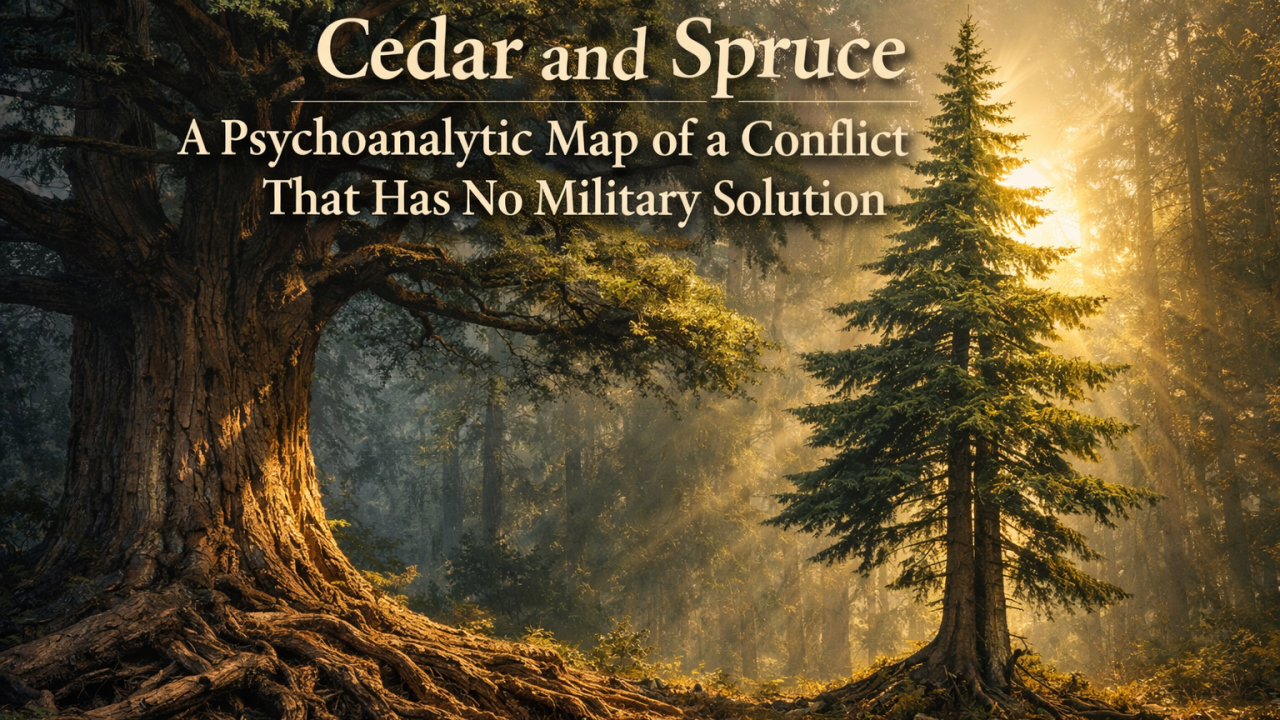
Perhaps genuine peace will come not when one side capitulates, but when both understand: we are different species. You are a Cedar, I am a Spruce. Our roots are intertwined, our branches look similar, but we are fundamentally two different trees. And that is not betrayal. It is growing up. The imperial experience is not just “history.” It is a psychological structure that still determines who they are and where they are going.
Culture: A Shared Code We Refuse to Acknowledge
Culture is the space where the common past hurts most acutely, because it is interwoven with living destinies.
Figures such as Nikolai Gogol or Oleksandr Dovzhenko bear witness to a complex imperial history. Gogol, Ukrainian in spirit, became a classic of Russian literature because the empire offered no other space for large‑scale expression. Dovzhenko, a genius of world cinema, was forced to create under Moscow’s watch, forever leaving his heart in Ukraine. Even Taras Shevchenko, formed in St. Petersburg, proved: one can be part of the imperial center and yet remain the voice of one’s own nation.
A special place belongs to Mikhail Bulgakov. A Kyivan who wrote about Kyiv but considered himself part of Russian culture. His White Guard is a hymn to the city he lost and to the world that disappeared. The Master and Margarita is a novel read for decades in the underground, copied by hand, passed from one person to another. It became a bedside book for many – in Kyiv as in Moscow. The path to its Ukrainian translation was long; it appeared only in 2005.
Today both sides try to “appropriate” Bulgakov. For some he is “ours,” for others “alien.” But he belongs to neither. He belongs to the place where he was born and to the time that cannot be brought back. And to those who recognized themselves in him – regardless of borders.
The Soviet period created the illusion of a “common cultural field.” Films, songs, books indeed shaped the tastes of millions, but we must acknowledge: this field was often sown from a single center. What appeared “common” was frequently the result of the absorption of local cultures by a great imperial machine.
Attempts to simply “divide” these creators are attempts to simplify a complex tragedy. Culture is indeed larger than politics, but it is not devoid of roots. Today’s process of “decolonization” is not merely a rejection of the alien; it is an attempt to restore to our names their true context. We are not nationalizing culture; we are returning honesty to it: we acknowledge where there was coercion, where there was appropriation, and where there was the sincere choice to be oneself.
Education: How We Were Taught About Each Other
Education is an instrument that shapes not only knowledge but also the understanding of the world.
The Soviet school: the same textbooks, the same holidays, the same heroes. History was taught as “the history of the USSR.” Kyivan Rus’ – “the cradle of three fraternal peoples.” The Pereiaslav Council – “reunification.” The wars against Napoleon, the Second World War – “our common glory.”
Now that this narrative has collapsed, millions find themselves in a void. They have nothing to lean on except old myths – or new ones, which are often no better.
Generations raised on the same myths can no longer understand each other. For they speak different languages – not only linguistically but also symbolically. The same event means something different to each.
Economy: A Shared Pie That Became Chains
Factories, mines, pipelines, and energy systems were built for decades not merely as an economy but as an inseparable complex. It was an architecture of total dependence: Donbas worked for Russian defense plants, Kryvyi Rih ore went to Magnitogorsk, and Ukrainian engines became the “heart” of Russian helicopters and missiles. The system was designed so that no republic could survive independently – breaking one link would halt the whole mechanism.
Millions on both sides lived off these connections. Relatives worked in the same giant enterprises, went for seasonal work, traded in the same markets. It was a world where borders in workshops and on railway tracks simply did not exist.
Yet this interdependence was not only about well‑being – it was about control. The gas transport system and power grids became instruments of geopolitical pressure. When Ukraine chose the path of European rules, the economy became a battlefield. Breaking these links came at a colossal price: for many industrial giants of the East it was a death sentence. For ordinary people – miners, engineers, railway workers – it was not just the loss of a job. It was the loss of the world in which they knew who they were.
These were powerful economic nodes. Only they were tied together incorrectly – not on the basis of long‑term cooperation, but with the aim of establishing and maintaining control. That is why they could not withstand the tension of rupture.
Today the question of economic cooperation after the war is the hardest. Any trade step will be seen as a “betrayal” of the memory of the fallen. Yet history teaches: without economic reconciliation there is no lasting peace. Future peace will be possible only when, instead of forced dependence, there emerges a space for partnership among equals, where the economy will never again be a weapon.
Memory: Common Places That Became Foreign
Millions of Ukrainians have ancestral graves on Russian territory. And vice versa. These are millions of invisible threads now cut by the front line. What is to be done with them? They will remain there forever, but the path to them now runs through minefields and closed borders. This is a private tragedy, where the impossibility of honoring one’s parents becomes a personal pain that cannot be healed by political agreements.
Shared places of memory – Babyn Yar, Khatyn, the Brest Fortress – once symbolized a common victory over evil. But today they have become a battlefield of narratives. Russia tried to monopolize this pain, turning the memory of the past war into a justification for a new one. As a result, common symbols have become toxic for many Ukrainians: it is hard to bow to common heroes together with those who are now destroying your home.
But the most painful thing is not that we cannot visit old graves. It is that we cannot bury the new ones. The bodies of the fallen remain on the battlefield, and families wait – and will never receive them. This is not just a loss. It is psychological tension of unreal scale for the families and loved ones of the 200,000 missing. These people are in a terrible psychological state, where the impossibility of burial becomes the impossibility of mourning. And the impossibility of mourning is the impossibility of letting go.
A painful question also concerns the desacralization of the past. When a shared history is used as a weapon, it ceases to be shared. Graves become hostages, monuments become targets. This rupture will leave a scar that will be felt for generations to come, because death in war closes the past but does not automatically grant access to the future.
We have not only lost common places – we have lost the right to common mourning.
What Is Kept Silent: Donbas, Debts, Soviet Legacy
Donbas: Eight Years of War Before 2022
We must say what people are afraid to say aloud. Donbas has been at war since 2014. There are people there who truly, sincerely, to the point of blood hate “Kyiv authority.” Their hatred is not propaganda. It is a rupture.
But to understand the depth of this rupture, we must look at Donbas not as a “territory” but as a psychic space shaped over centuries.
Historical Root: An Imperial Project That Became a Trap
Donbas did not arise by chance. It was created as the heart of imperial industry. In the 19th century – as the “all‑union stoker.” In the 1930s – as the miners’ outpost of industrialization. In the postwar decades – as a symbol of Soviet might.
People were brought from all over the empire. Russians, Ukrainians, Belarusians, Jews, Greeks – they all became “Donbasians.” This was an identity forged from labor, not nationality. The mine did not ask about your passport. It asked whether you could meet the quota.
Soviet power created here the archetype of the “hero‑toiler.” The miner was not merely a worker – he was a myth. His labor fed the empire. His hard lot justified any sacrifice. This archetype penetrated flesh and blood.
But when the empire fell, the archetype turned into a trap. The mine remained, but the meaning vanished. The economy collapsed. People accustomed to being “breadwinners” suddenly became “excess.” And then the main mechanism that today determines the fate of Donbas appeared.
Psychological Mechanism: Projection of the Shadow and the Narcissism of Lost Greatness
Jung taught us: what we cannot acknowledge in ourselves, we project onto the other. When a person who for decades was a “hero” suddenly becomes “nobody,” their psyche looks for a culprit. And finds it where it is easiest – in the “alien” center.
“Kyiv authority” became for Donbas a shadow figure. Onto it were projected everything: contempt for miners’ labor, economic incompetence, linguistic humiliation. And the more real problems accumulated, the more this shadow grew.
Freud would add: when identity is built on labor rather than nationality, any attempt to change language, symbols, cultural code is perceived not as reform but as destruction of self. The Ukrainian language for Donbas became not just a language – it became a symbol of loss. Loss of work, loss of status, loss of the world in which you were a hero.
2014: A Bifurcation Point No One Understood
When the conflict began in 2014, Donbas was already primed for explosion. But it is important to understand: what erupted was not “separatism.” It was the psychological tension accumulated over decades.
Local authorities fled. There was no army. People accustomed to being “taken care of” from Moscow found themselves in a void. And into that void came those who offered a simple narrative: “Kyiv betrayed you. Moscow will protect you.”
For a person who had lost work, status, meaning, this narrative became a lifeline. It restored the archetype of the “hero,” only now the hero fought not coal but “nationalists.” It restored the feeling of belonging to something great – now not Soviet, but the “Russian world.”
The way out of this situation will be difficult.
“What You Came With, Leave With That”
Sobchak said this in 1991. And he was right. Ukraine inherited borders drawn by Soviet power; industry built with all‑Union funds; infrastructure built by the whole empire; an army inherited from the USSR.
This was not a “gift.” It was a legacy that had to be divided. And Russia still considers that division unfair.
Without Soviet investments, Ukraine in its current borders would not exist. Not because “Russia created Ukraine,” but because the empire built infrastructure without regard to future borders.
To acknowledge this is not to be “grateful.” It is to see reality. For as long as we do not see it, we cannot build a future.
External Debt: Who Paid? After the collapse of the USSR, Russia took upon itself the entire external debt – about 100 billion dollars. Ukraine did not pay. This is a historical fact that Russia uses as an argument. It is not a justification for aggression. But it is a reality that will have to be taken into account in negotiations.
Ukraine Was Built with Soviet Money
Kharkiv Tractor Plant, Kryvorizhstal, DniproHES, ports, roads, Donbas mines – all were built with all‑Union funds. Money was collected from all republics and invested where resources or industry were located.
This is not “Russian money.” It is Soviet. But Russia considers itself the heir of the USSR. And for Russia this argument is key.
We can answer: “and you used Ukrainian workers, Ukrainian resources.” That is true. But it does not cancel the other truth: without imperial investments, Ukraine would have been an agricultural country without heavy industry.
Again – this is not a justification for war. It is context, without which negotiations are impossible.
We Are Not Brothers. We Are Two Trees That Grew from One Root. And That Is Not a Tragedy – It Is Nature.
The true purpose of the root is not to hold branches together by force. It is to give each the strength to grow.
Ukraine has already chosen its sky. Russia still has a choice. But as long as it does not recognize that distinctiveness is not betrayal but coming of age, the war will not end. It will change form, but it will not disappear.
For individuation always brings pain. But without that pain there is no birth.
Instead of a Conclusion – A Parable
The Price of One’s Own Sky
Once, two seeds fell into the same soil. The same rain watered them, the same sun warmed them, and their roots intertwined so tightly that it seemed they were one organism, one destiny, one trunk.
One seed dreamed of height. It grew into a Cedar – proud, massive, convinced of its exceptionality. The Cedar was used to thinking it was the center of the forest, and its branches were the whole sky. It did not notice how under its broad crown another soul was growing.
Beside it rose a Spruce. For a long time it was silent, accustomed to being “protected” by the shadow of the great neighbor. It even believed they were one whole, until inside it awoke the call of its own nature. A day came when the Spruce felt: its branches were cramped. It realized it had the right to its own sun and its own name. This was not rebellion against the Cedar – it was the birth of Self.
But the Cedar saw this as betrayal. It did not know how to be great without someone bowing beneath it. It was used to thinking of the Spruce as its lower branch, part of its body. And when the Spruce whispered to the wind, “I am not him,” the Cedar began a war. It threw all its weight to crush the Spruce, trying to block every ray of light, proving that without it the Spruce was only a splinter.
Yet the Cedar was mistaken. It did not consider that the Spruce’s strength is forged precisely in the shade. Trying to crush it, the Cedar only forced the Spruce’s roots to go deeper into the earth, and its trunk to become hard as steel. Every attempt by the Cedar to break it only added fury and resilience to the Spruce. It learned to hold the sky by itself.
Today the Spruce is winning its space. It is learning to grow not “under” but “beside.” And though breaking the symbiosis is painful, it already knows: true greatness lies not in dominating another, but in having the courage to be oneself.
The Cedar will remain with its shadow, and the Spruce with its own sky.
From the Author
I have not mentioned the Presidential Office once in this text. Not because I forgot, but because there is no place for it in this conversation.
For this text is not about power. It is about people.
About those who are absent from official reports yet hold up the sky. About the rear army that exists without orders. About millions who feed, sew, repair, evacuate, return, heal – and do it not because someone told them to, but because there is no other way.
These people deserves respect. Not sympathy. Not PR. Respect for their voice, expressed in daily, fierce, exhausting support of the front.
And if after all we have been through someone still thinks Ukraine can be “divided” or “returned” – let them look at this army. It does not wear uniforms. But it will not retreat.
The Children Who Grew Up
Commonality does not cancel distinctiveness. On the contrary, it makes distinctiveness meaningful.
We emerged from one root. We share language, history, trauma, corruption, families, faith, culture, memory. But we are different. And that is not tragedy. It is coming of age.
Ukraine has a chance to become what Russia failed to become: a free, democratic, European country. And in this there is no betrayal of a common past – it is its best continuation.
For the true purpose of an ancestor is not that children repeat their mistakes, but that they go further.
And when today we speak of Donbas, Crimea, “special status,” or “historical justice,” we are speaking of the same logic as the brothers who could not divide Charlemagne’s empire. Of a territory that could become a problem not for years but for generations – if the solution is not genuine.
A genuine solution is not redrawing borders. It is recognizing that we are no longer brothers. We are neighbors. And neighbors can live side by side, even if they once shared a common home.
This text is not an excuse for the aggressor. Nor is it a denial of pain. It is an attempt to see the truth that lies deeper than political slogans.
If it provokes resistance – ask yourself: is it perhaps because you are accustomed to seeing only black and white? But the truth is always colored.
Sometimes it is the color of blood.
P.S.
I have read and analyzed all of Putin’s programmatic articles on Ukraine. This text is not a response to them. It is an attempt to see what he fundamentally refuses to see: our shared complexity. And if someday in the Kremlin they dare to have such a conversation – the door is open. But not from the position of “we are taking you back,” but from the position of “we are ready to talk as equals.” For in Ukraine, they say: “you cannot crush genes with your fingers.”
Leave a Reply